
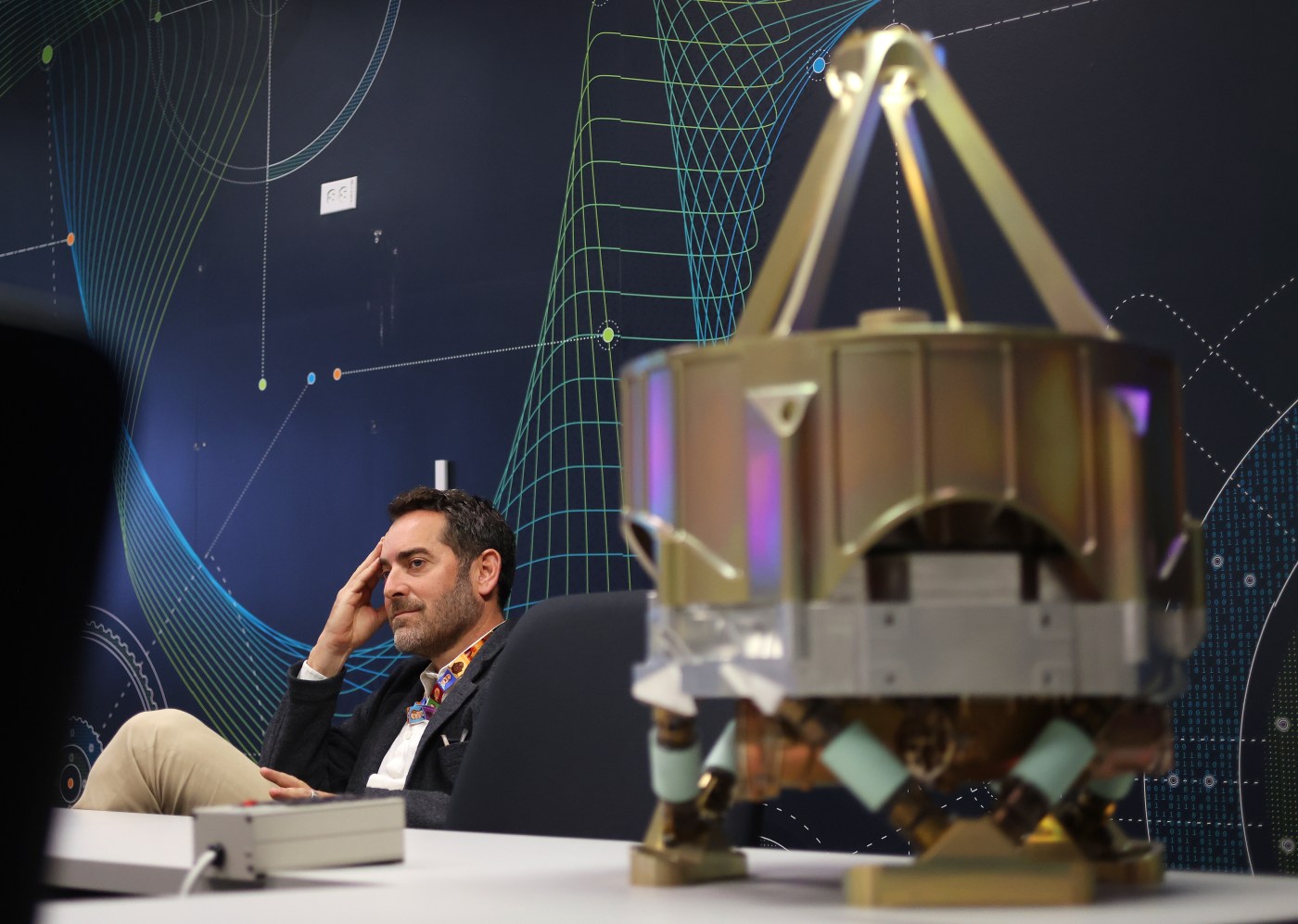
Amid a new wave of interest in the possibility of life on other worlds, Lawrence Livermore National Laboratory and NASA are embarking on a new effort to identify planets with the basic compounds for life when they launch a small satellite from Vandenberg Space Force Base in Santa Barbara in January.
The 13-month Pandora Mission will attempt to capture the atmospheric conditions of 20 planets as they eclipse their respective suns, an effort to aid the James Webb Space Telescope’s photographing of planets orbiting vibrant, young stars.
The Pandora team is hoping to find biosignatures — chemicals that can only be produced by a living organism such as oxygen, carbon dioxide and methane — which provide evidence of past or present life, though the chance of finding those gases is almost infinitely small, said Peter McGill, an optical astronomer on the Pandora Mission. But data gathered in the project could help answer some of humanity’s biggest questions.
“Are we alone? How do we search for life?” McGill said. “To detect something like a biosignature, or to look for life, you need to really have a good measurement of the atmosphere of your exoplanet. And to do that, you need to understand the star.”
The Pandora mission will be the first satellite launched into space as part of the Pioneers Program – a name that serves as an homage to NASA’s original Pioneers Programs that explored planets in our solar system – that will expand the horizons of the original program to capture information from planets 100 light years away. The targeted planets are all hosts of young stars, which are difficult to capture via telescope because of “solar contamination” — unwanted signals from a star that create false data.
“This is the first full NASA science mission that we have managed for this kind of spacecraft,” said Ben Bahney, leader of the LLNL Space Program. “It’s a culmination of at least six or seven years of direct effort, from proposal all the way through to launch.”
Before scientists understood the limits of the James Webb Space Telescope (JWST) to cut through solar contamination, LLNL scientists were conceiving of the Pandora mission as a fix, said Jordan Karburn, engineer of small satellite capabilities for the Pandora Mission. Karburn said the LLNL scientists had previously worked on space telescopes like Hubble and Kepler, so they were conscious of the potential limitations.
“The core members of the (LLNL) science leadership team knew that stellar contamination was going to be problematic, and they sort of tailor-made this small satellite mission, i.e. Pandora, to help address this problem,” Karburn said.

Pandora works like this: while planets floating in the void of space are too dark for telescopes to capture, astronomers can take photos of exoplanets as they cross the face of a star, Karburn said. Scientists then use a spectrometer, a tool which measures the wave lengths of light from the makeup of a planet, revealing its unique chemical fingerprint. Put simply, it’s addition by subtraction.
“With Pandora, we can then combine this data with James Webb, remove the noise from the spectrum and learn robust properties about exoplanets,” Karburn said.
While Pandora’s primary goal is to abet the understanding of exoplanets, its secondary goal is showing the capability of public partnerships with commercial space-faring companies for space exploration. NASA’s reputation for creating huge engineering feats also comes at great expense, Karburn said.
But Pandora represents a “new class” of mission to create new scientific capabilities at a fraction of the cost — seven times less than what NASA had initially estimated, according to the Pandora team.
“Things like (the James Webb telescope) are $10 billion-plus missions, right? So NASA is used to spending an incredible amount of money to drive totally unique capabilities in space,” Bahney said. “The (Pandora) instrument alone is about seven times cheaper than what NASA says that it should be… One of our biggest ‘fights,’ so to speak, was convincing NASA that it was credible because we were so under budget.”
The Pandora Mission satellite will be packed onto a SpaceX rocket in early January with a payload of 21 other satellites for a variety of commercial and scientific endeavor. While the official launch date for the Pandora Mission rocket has not yet been announced – a deliberate choice to protect national security — it is expected to leave the Vandenberg Space Force base some time after Jan. 5. Upon leaving Earth’s atmosphere, the SpaceX rocket will release Pandora, and the LLNL team will commission the small satellite to glimpse into space for signs of life among the stars.
“This is a major undertaking, and the fact that we’re now ready for launch is extremely exciting,” Bahney said. “There’s a really significant potential here for Pandora to have a huge science impact.”
The Mercury News







Leave a Reply