

Welcome to One Fine Show, where Observer highlights a recently opened exhibition at a museum not in New York City, a place we know and love that already receives plenty of attention.
It feels like audiences are craving a sequel to the summer blockbuster that was last year’s “Manet/Degas” show at the Metropolitan Museum of Art. The John Singer Sargent show had material that was just as good, but I doubt it was as popular, given the lack of the frenemies narrative that existed in the earlier show. Frenemies will always be big in America, the country where you always have to keep buying a bigger car so you don’t have to worry about crashing into your neighbor’s even bigger car.
The wall text for “Manet & Morisot,” a new exhibition at San Francisco’s Legion of Honor, reminds us that Édouard Manet (1832-1883) and Berthe Morisot (1841-1895) “had the closest relationship between any two members of the Impressionist circle.” Fair to say they weren’t frenemies, but nor were they artist and muse, nor master and pupil, as some of their contemporaries thought. The show explores the interplay between their careers through 42 works on loan from major institutional collections across the United States and France.
Manet and Morisot met at the Louvre in the late 1860s, which they both frequented to copy old masters. Shortly after meeting Berthe and her sister, Manet wrote to a friend, “It’s a bother they’re not men, but as women, they could still serve the cause of painting by marrying an academician each and sowing discord in the dotards’ camp.” Let’s call that a contemporary compliment, because he couldn’t have known how Berthe would help him shake up the medium with her own hand.
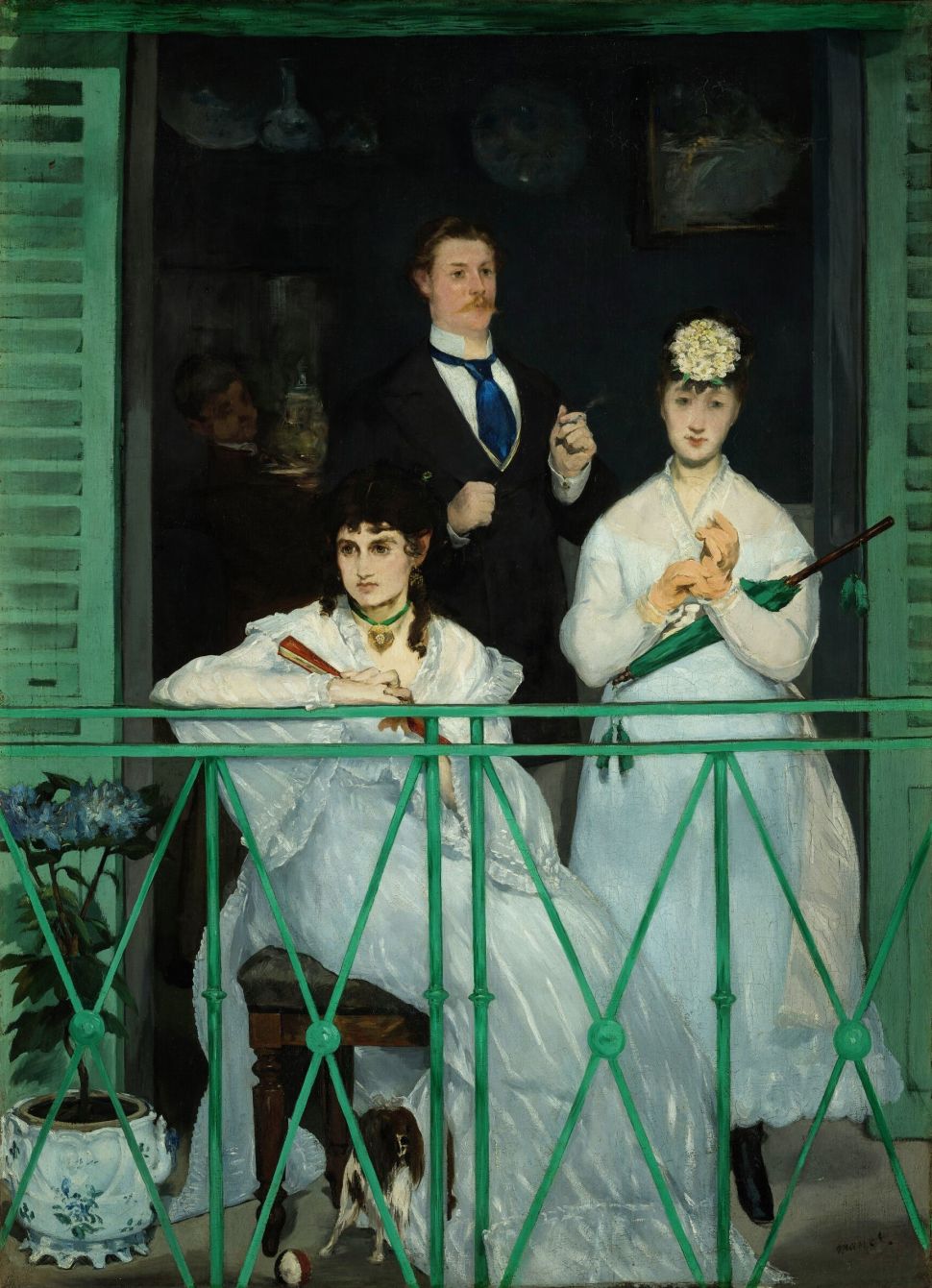
Not long after, she would serve as the main model for The Balcony (1868-1869), which has a rich narrative in which Morisot is the star. Someone is about to arrive or is so late that she’s given up on him arriving—Morisot’s character is concerned with something else entirely, her gaze locked on something beautiful or nonexistent off the balcony.
He did like his otherworldly women. Morisot became a frequent subject and friend. Manet’s praise of The Harbor at Lorient (1869) in the studio was so effusive that she gifted him the work, to the displeasure of her mother, but the work does reflect his influence. The way the harbor reflects the sky and its surrounding walls offers just that right mix of fantasy and realism. There’s even a dreamy woman framing the scene.
This isn’t to say her style was in any way derivative of his. Manet was influential on all the Impressionists, even if he wasn’t officially one himself. The pallor in The Harbor at Lorient would go on to define her brand, with one critic praising the “perfumed whiteness” of her Woman at Her Toilette (1875-1880). Her big, open strokes and subtle colors are on display with this one. You almost worry that if you sneeze, it’ll blow away—quite a departure from Manet’s well-deployed sturdiness.
Manet’s death in 1883 left Morisot “broken,” she wrote to her sister: “I shall never forget the old days of friendship and intimacy with him, while I posed for him and his charming wit kept me alert through those long hours.” This was a fascinating relationship from which both received much, the evidence of which is on the canvas.
“Manet & Morisot” is on view at the Legion of Honor through March 1, 2026.
More exhibition reviews
-
Dutch Golden Age Treasures from Thomas Kaplan’s Leiden Collection Take Center Stage in West Palm Beach
-
At SLAM, Anselm Kiefer’s Material Transformations
-
One Fine Show: “The Stars We Do Not See, Australian Indigenous Art” at the National Gallery of Art
-
In Rotterdam, Mandy El-Sayegh Offers Up an Assault on the Senses
-
Samuel Sarmiento’s Ceramics Channel Universal Memory in His U.S. Debut
Observer












Leave a Reply