


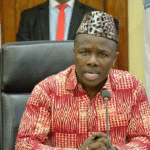
Monrovia- Nimba County District Representative Musa Hassan Bility has condemned the Legislature’s handling of port reform legislation, describing the proposed Port Autonomy Law as “improper” and “dangerous.” He warned that its passage without due process risks plunging Liberia’s port system into confusion and institutional chaos.
By Jaheim T. Tumu-jaheim.tumu@frontpageafricaonline.com
Bility’s comments come amid a deepening constitutional and political confrontation following the Legislature’s decision to re-pass the controversial port reform bills in defiance of President Joseph Boakai’s veto, intensifying tensions over the future control, structure, and governance of Liberia’s maritime sector.
“Look, that law is not good. It’s improper, and it’s intended to throw our port system into chaos,” Bility said, reacting to the Legislature’s insistence on pressing ahead despite presidential and legal objections.
He stressed that the legislation was rushed through the House of Representatives without the scrutiny required for reforms of such magnitude.
Accordingly, he said the House abdicated its core responsibility by passing the bills without public hearings, expert testimony, or meaningful deliberation.
“There was no hearing. You are not an expert,” he said, taking aim at his colleagues. “Our House of Representatives passed that bill with disdain. Nothing they did. No debate. No argument. Nothing. Yes and no. It is shameful.”
He argued that the process violated legislative norms and further eroded public confidence in an institution already under intense scrutiny.
Despite President Boakai’s decision to veto key portions of the port reform package, lawmakers re-passed the legislation, signaling what critics describe as a deliberate challenge to the Executive’s constitutional role.
The Legislature’s action underscores a firm resolve to dismantle the National Port Authority (NPA) and replace it with a new regulatory and decentralized port management regime, notwithstanding sustained objections from the President and strong legal warnings from the Ministry of Justice.
The re-passed legislation consists of two interrelated measures: the Liberia Sea and Inland Ports Regulatory Authority Act of 2024 and the Liberia Sea and Inland Ports Decentralization and Modernization Act of 2024.
Taken together, the Acts repeal the National Port Authority Act, dissolve the NPA, establish four autonomous seaports in Monrovia, Buchanan, Greenville, and Harper, and create a new Liberia Sea and Inland Ports Regulatory Authority with expansive oversight powers over ports and maritime activities nationwide.
Before the re-passage vote, the Joint Committee informed plenary that the President’s objections were largely limited to nomenclature and formatting issues, including the table of contents — an assessment critics say grossly minimized the depth and substance of the concerns raised in the veto message.
President Boakai returned the bills to the Legislature in line with Article 35 of the Constitution, stating that he acted “by virtue of the authority in me vested” and urging lawmakers to reconsider the measures in the broader interest of national stability and effective governance.
In his veto message, the President emphasized that the two Acts are legally and operationally inseparable, warning that autonomous ports cannot function properly without a clear, coherent, and constitutionally sound regulatory framework.
Passing one law without addressing defects in the other, he cautioned, would create fragmentation, uncertainty, and institutional instability within the maritime sector.
Despite these warnings, the Legislature proceeded to re-pass the legislation without materially addressing the defects identified by the President, fueling accusations that lawmakers are weakening the constitutional role of the Executive by re-enacting substantially similar laws while disregarding the substance of a presidential veto.
However, Bility insisted his opposition is not to reform or decentralization in principle, but to what he described as reckless and poorly thought-out lawmaking.
“I believe that the ports around the country should have some level of independence,” he said. “But the question is, don’t they already have it?”
Drawing on his experience, Bility asserted his authority on port governance. “I’ve been chairman. I’m an authority here. I’ve been in the senior management. I’ve appointed three managing directors in the past,” he said.
Under the current system, he explained, ports already enjoy significant operational autonomy. “A significant decision of the port is made by the port manager and the management,” Bility noted.
He criticism is what he described as the absence of a coherent reform strategy. “If you are about to make a change, what is the master plan? How do you fix the act? You don’t do things like that,” he argued.
He warned that the proposed laws contradict their stated objectives. “You say you want to reduce and localize the team, but in your act, you create even more bureaucracy and take power from maritime and give it to this so-called board now that you’re setting up,” he said.
Central to the dispute is a comprehensive legal opinion issued on July 14, 2025, by Justice Minister and Attorney General Oswald Tweh. While acknowledging the Legislature’s constitutional authority to enact and repeal laws, he warned that the proposed restructuring represents one of the most far-reaching institutional changes since independence and therefore requires careful constitutional scrutiny, practical assessment, and close coordination with the Executive.
The Attorney General cautioned that the Liberia Sea and Inland Ports Regulatory Authority Act creates a framework that departs sharply from both established domestic governance trends and international best practices.
The Act grants the proposed Authority sweeping powers to approve tariffs and fees, regulate port operations, oversee vessel and seafarer safety and security, implement international maritime conventions, and simultaneously develop and operate port facilities.
According to the opinion, combining regulatory, oversight, and operational functions within a single institution undermines regulatory independence and creates inherent conflicts of interest.
Equally troubling, the Attorney General warned, was the Legislature’s exclusion of the Executive from the reform process. While the Constitution does not require executive consultation before passing legislation, Tweh cautioned that unilateral action on reforms of this scale forfeits the benefit of executive expertise and institutional knowledge.
He noted that executive agencies possess detailed familiarity with port operations, contractual obligations, and international maritime commitments — insights that could have strengthened the laws and reduced implementation risks.
The opinion further warned that dissolving a major government agency and creating multiple new entities without executive collaboration places the President in the awkward position of being constitutionally required to implement a system he had no role in designing, risking inefficiencies, administrative confusion, and weakened governance.
President Boakai echoed these concerns, pointing in particular to the overlap between the proposed ports regulator and the Liberia Maritime Authority (LiMA), traditionally responsible for maritime safety, vessel inspection, seafarer certification, port security, and enforcement of international maritime conventions.
The Liberian Leader warned that transferring these responsibilities wholesale to the new Regulatory Authority would erode LiMA’s statutory mandate, leaving it largely redundant and potentially undermining Liberia’s compliance with international obligations.
The Decentralization and Modernization Act has drawn additional criticism for repealing the National Port Authority without providing robust transition mechanisms for an institution with substantial assets, liabilities, long-term contracts, and a large workforce.
President Boakai warned that abruptly dissolving the NPA and assigning transition responsibilities to a limited working group could spark legal disputes, operational disruptions, and financial uncertainty.
He also cautioned that the proposed six-month transition period may be insufficient and could violate Article 25 of the Constitution, which protects contractual obligations.
He further pointed to internal inconsistencies in the legislation, including references to inland ports in the title without substantive provisions addressing them, defects that could necessitate repeated amendments and generate future confusion.
Further stressing, Bility urged lawmakers to halt the process and adopt a more professional, evidence-based approach.
“What we should have done immediately was to receive that bill and begin to have public hearings,” he said. “Bring experts, even go to other ports. Go to Sierra Leone, Ghana, and Côte d’Ivoire and see in our neighborhood how ports are run.”
He emphasized that oversight should not be confrontational. “Oversight is not an adversarial position,” Bility said. “That’s inter-branch collaboration.”
He cautioned that reckless lawmaking could damage one of Liberia’s most critical economic lifelines.
“Since the 1940s, we have had a system, and you wish to change it,” he said. “Can you take time? Can you create a transition?”
The post Liberia: ‘Port Autonomy Law Improper and Dangerous,’ – Bility Warns as Legislature appeared first on FrontPageAfrica.



Leave a Reply