
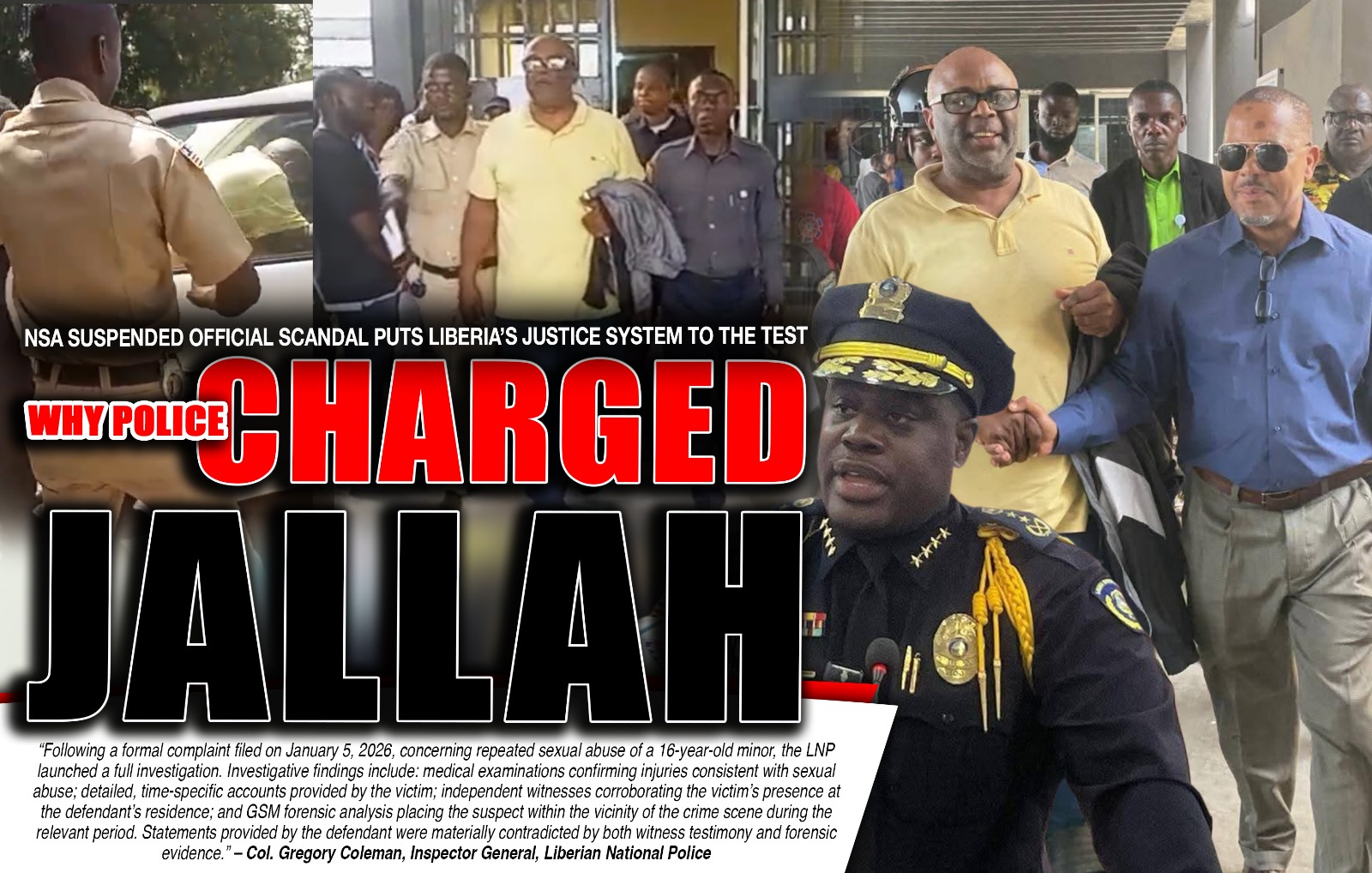
Monrovia-The imprisonment of Peter Bonn Jallah, a suspended senior aide to Liberia’s National Security Agency (NSA), Director Prince C. Johnson, at the Monrovia Central Prison marks more than the progression of a criminal case.
By Willie N. Tokpah
It represents a moment of reckoning for Liberia’s justice system, one that tests whether the law can operate without fear or favor when allegations reach into the upper ranks of national security.
Jallah, a Special Assistant to the NSA Director, Maj. Gen. Prince C. Johnson, has been formally charged with gang rape, statutory rape, and kidnapping involving a 16-year-old boy.
The Liberia National Police (LNP), following an investigation led by the Women and Children Protection Section (WACPS), forwarded the matter to the Monrovia City Court, where a judge ordered his remand pending further judicial proceedings.
In a country still grappling with legacies of impunity and institutional mistrust, the case has ignited public debate not merely about the alleged conduct of one man, but about the structural vulnerabilities that allow authority, access, and silence to intersect, often at the expense of children.
Weight of the Allegations
According to police charge sheets (RID#014-2026), the state alleges that the accused sexually abused the minor on multiple occasions between late November 2025 and early January 2026.
Prosecutors have invoked serious felony provisions of Liberia’s Penal Law, charges that, if proven, carry severe custodial penalties.
Investigators allege the victim, a community-based soccer player from Sinkor, was targeted through a pattern of grooming, small cash payments for chores, cultivated familiarity, and ultimately the promise of football boots.
Police say this inducement culminated in the child being taken to an unknown residence near Camp Johnson Road, where he was allegedly drugged and repeatedly assaulted over several days.
The victim was later discovered in a distressed and critical condition near a beach in Sinkor and transported to the John F. Kennedy Memorial Hospital, where he continues to receive treatment.
Evidence, Not Emotion
In cases of this gravity, courts are guided not by outrage but by evidence.
Police say medical examinations at JFK’s One-Stop Centre revealed injuries consistent with sexual assault.
Digital forensic analysis allegedly placed the accused within the vicinity of the crime scenes, challenging assertions that he had no contact with the victim.
Witness statements reportedly corroborate sustained interaction between the accused and the minor, while others claim they physically rescued the boy in a state of distress on the night he was found.
Police Inspector General Col. Gregory O. W. Coleman has publicly committed the LNP to pursuing all individuals connected to the alleged crimes, including two suspects who remain at large, an assurance that will be measured not by words, but by arrests and prosecutions.
Power, Proximity, and the State
What renders this case uniquely consequential is not only the nature of the allegations, but the institutional proximity of the accused to the nation’s security leadership.
For critics, the question is unavoidable. How many warning signs are missed when authority figures operate within communities marked by poverty, admiration, and limited oversight?
The NSA’s decision to suspend Jallah pending trial reflects procedural prudence, yet suspension alone does not answer the broader concern of whether internal accountability mechanisms are robust enough to detect, deter, or disrupt abuse before it escalates into criminal prosecution.
Due Process Under the Spotlight
Jallah’s legal team has challenged aspects of his detention, filing a writ of habeas corpus over alleged violations of statutory holding periods. Such challenges are not technical distractions; they are essential components of constitutional democracy.
The legitimacy of any eventual verdict, guilty or not, depends on scrupulous adherence to due process.
At the same time, Liberia’s courts must ensure that procedural rigour does not become a shield for delay, disappearance of evidence, or intimidation of witnesses, failures that have historically eroded public confidence in high-profile prosecutions.
A Test Larger Than One Defendant
Legally, Peter Bonn Jallah stands presumed innocent until proven guilty. That presumption is non-negotiable.
Yet institutionally, the state is already on trial in the court of public conscience.
This case will test whether Liberia can protect minors when alleged perpetrators wield influence and prosecute serious crimes without political interference.
Pursue co-suspects with equal resolve, and deliver justice that is not only done, but credibly seen to be done.
The Stakes
If mishandled, the case risks reinforcing cynicism that power still bends the law.
If prosecuted with independence, transparency, and professionalism, it could signal a decisive shift toward accountability, especially within the security sector.
For now, one man sits behind bars awaiting his day in court. But the ultimate judgment will fall not only on the accused, but on Liberia’s institutions themselves, and on whether the rule of law can withstand its most difficult test, confronting allegations against those closest to power.
PRESS BRIEFING
Liberia National Police
Good morning to all, and a happy and prosperous New Year to each and every one of us. I extend greetings to members of the press, fellow Liberians, and everyone listening to this press briefing.
The Liberia National Police (LNP) has convened this briefing to provide a comprehensive, transparent, and evidence-based update on three serious criminal investigations that have attracted significant public attention.
These cases underscore the fundamental principles that guide the Liberia National Police, namely:
The protection of victims, especially children and other vulnerable persons;
Strict adherence to due process and the presumption of innocence; and
Decisions driven by evidence, not public pressure, speculation, or social media narratives.
I will address each case individually, outline the investigative steps taken, and clarify the outcomes reached, strictly based on facts and the law.
Case One: G. Brian McGill Investigation
The Liberia National Police conducted an extensive, multi-layered criminal investigation following a rape allegation involving a 14-year-old minor and Mr. G. Brian McGill.
Key investigative actions included:
GSM call data and cell site location analysis;
Independent GPS location verification;
Review of available CCTV footage; and
Full DNA forensic analysis conducted through international forensic partners.
Findings:
Telecommunications and GPS data conclusively excluded Mr. McGill’s presence at the relevant location and time;
CCTV footage did not support claims of his presence at the alleged crime scene; and
DNA forensic results excluded Mr. McGill as a contributor to the biological material recovered from the victim’s clothing.
While unidentified male DNA was detected, it did not match Mr. McGill.
Based on the totality of digital, forensic, and physical evidence, the Liberia National Police has exonerated Mr. G. Brian McGill from this investigation. However, the investigation remains open, and efforts continue to identify the unknown DNA contributor.
This case demonstrates the LNP’s commitment to protecting victims while ensuring fairness, objectivity, and due process. We encourage the victim’s family to continue cooperating with the police as we work together to bring the perpetrator, who remains at large, to justice.
Case Two: Peter Bon Jallah
The second case involves Mr. Peter Bon Jallah.
Following a formal complaint filed on January 5, 2026, concerning repeated sexual abuse of a 16-year-old minor, the LNP launched a full investigation.
Investigative findings include:
Medical examinations confirming injuries consistent with sexual abuse;
Detailed, time-specific accounts provided by the victim;
Independent witnesses corroborating the victim’s presence at the defendant’s residence; and GSM forensic analysis placing the suspect within the vicinity of the crime scene during the relevant period.
Statements provided by the defendant were materially contradicted by both witness testimony and forensic evidence.
Legal Action: Based on probable cause, the Liberia National Police has formally charged Mr. Peter Bon Jallah under the Revised Penal Law of Liberia with:
Statutory Rape,
Sodomy (Chapter 14.70),
Gang Rape (Chapter 14.702), and
Kidnapping (Chapter 14.51).
The defendant has been forwarded to court, and the matter now lies before the Judiciary. Mr. Jallah is presumed innocent until proven guilty. The identity of the victim has been fully protected in accordance with the law.
This case reflects the LNP’s commitment to swift, victim-centered, and evidence-based prosecution where facts support criminal charges.
Case Three: Joseph Butler
The third case involves Mr. Joseph Butler and follows the circulation of a video on social media showing children engaged in harmful conduct involving fireworks.
A swift investigation was launched, resulting in Mr. Butler’s arrest.
Key findings:
The victims are the defendant’s biological children, aged five and six;
The defendant admitted to producing and posting the video;
Investigations confirmed that the content was harmful, degrading, and exploitative; and
The video was created as part of income-generating activity on social media.
Mr. Butler has been charged and forwarded to court.
Charges include:
Subjecting children to harmful practices (Section 16.115, Children’s Act of 2011);
Subjecting children to exploitation or abuse by a parent or service provider (Section 16.10, Children’s Act of 2011);
Endangering the welfare of children (Section 16.4, Children’s Act of 2011); and
Dissemination of obscene materials (Chapter 18.7, Penal Law of Liberia).
This matter is now before the court.
Parental authority does not excuse exploitation, and social media is not a shield against accountability.
Conclusion and Public Advisory
Across these three cases, the Liberia National Police has acted independently, professionally, without fear or favor, and in strict conformity with the laws of the Republic of Liberia.
We protect victims, safeguard due process, resist misinformation, and allow the courts—not public opinion—to determine guilt or innocence.
We urge the public and the media to rely on verified information released by the Liberia National Police, refrain from speculation, avoid disinformation, protect victims’ identities, and respect the integrity of ongoing judicial proceedings.
The Liberia National Police remains resolute in its duty to protect life, dignity, and the rule of law.
Before closing, I wish to thank the general driving public for the cooperation shown during the ongoing road engineering works along Tubman Boulevard. We urge all road users to remain patient and responsible. Using the opposite lane is dangerous, inconsiderate, and puts lives at risk. No one has greater rights than others on the road.
Additionally, vehicle owners are advised to remove unauthorized security devices and emergency lights from their vehicles. The police have been instructed to enforce this regulation aggressively.
Thank you for your attention.
At this time, we will take your name and institutional affiliation.
The post Liberia: NSA Suspended Official Scandal Puts Liberia’s Justice System to the Test appeared first on FrontPageAfrica.


Leave a Reply