
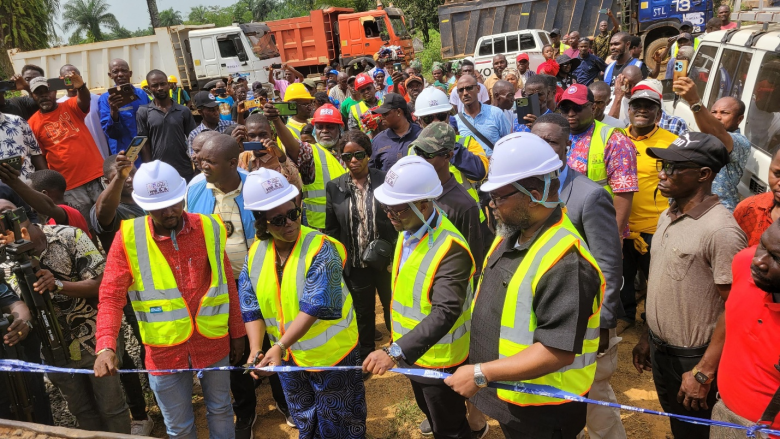
Buchanan– The Liberia Special Economic Zones Authority (LSEZA) has turned over the Special Agro-Processing Zone (SAPZ) project site in Grand Bassa County to the contractor, HM & A, marking a major milestone in the Government of Liberia’s agro-industrial development agenda.
By Jaheim T. tumu-jaheim.tumu@frontpageafricaonline.com
Under the African Development Bank (AfDB)-funded contract, HM & A will carry out site clearing, fencing, creation of access for power transmission lines, and construction of a 4.7-kilometer access road leading to the proposed agro-industrial park.
The project, expected to last for 18 months, covers over 210 hectares of land designated for the development of a modern Special Agro-Processing Zone.
The land was voluntarily provided by residents of the affected communities, who were resettled by the Government of Liberia through the approved Resettlement Action Plan (RAP).
Liberia’s long-stated ambition to move from raw agricultural production to value addition took a concrete step forward as the Liberia Special Economic Zones Authority (LSEZA), the African Development Bank (AfDB), and the Government of Liberia officially advanced work on the Special Agro-Processing Zone in Buchanan.
Addressing, Senate Pro-Temporary, Nyonblee Kangar-Lawrence said that the project is designed first and foremost for ordinary farmers across the county and beyond.
“Most of us who will benefit from this might not understand actually what it is, and I would like to just break it down in simple terms for our people,” she said.
Kangar-Lawrence explained that farming communities in Grand Bassa suffer not because they do not produce, but because they lack buyers, storage, and processing facilities.
“Our people in these different districts live on farming. When it goes further into Grand Bassa County, produce are cheaper because of the rural condition. One, secondly, there are no buyers so they have nowhere to carry the farm produce and make money,” she noted.
According to her, the essence of the agro-economic zone is to create a centralized industrial space where farmers can bring their produce, investors can process raw materials, and value can be added locally.
“The essence of this agro-economic zone is to build a space where there will be public-partner relationship, industrialization, warehouses will be there. If you grow your plantain or cassava, whatever, you have a place to take it,” she said.
“And there will be processed hopefully into finished products where you can have ‘Made in Liberia’ or ‘Made in Grand Bassa County’.”
She described the project as a key part of decentralizing economic growth, saying it would create jobs, relieve farmers, and attract investors to the county.
“That is the kind of decentralization we support because it’s an economic boost. Our people will get jobs, our farmers will be relieved, and we have investors coming to our county,” Kangar-Lawrence emphasized.
However, she warned that the full benefits of the agro-processing zone depend on another critical reform: the commercialization of the Port of Buchanan.
“As we stand here, the port of Buchanan is not commercialized. It’s not a commercial port,” she said, noting that without a functioning commercial port, investors would still be forced to transport containers to Monrovia.
“You don’t want them to take the containers all the way to Freeport to ship. Then you’re not boosting the economy in our county.”
She said lawmakers have cleared legislative hurdles and are hopeful that the President will sign the bill to commercialize the port. “We have cleared that veto and we’re looking forward to the President signing this one this time,” she disclosed.
Kangar-Lawrence urged residents not to politicize the project. “This is development. Let’s do it together. Let us not politicize this. Let us work in unity and make sure that we support this development,” she said, adding that the next phase will focus on attracting investors to take advantage of the zone.
VP Koung’s Proxy Says Compensation Is a Right
Proxying for Vice President Jeremiah Kpan Koung, Deputy Chief of Staff for Administration, Macdonald Metzger, described the project as a clear demonstration that development must be people-centered.
“Compensation is not a favor, it is a right, and it reflects our resolve to ensure that communities are partners, not casualties of national progress,” the Vice President’s proxy declared at the formal turning-over ceremony of the project site.
According to Metzger, SAPZ is a flagship initiative aligned with the government’s ARREST Agenda, particularly its focus on agriculture-led growth, job creation, rural transformation, and food security.
“Today’s event marks an important milestone in the implementation of the Special Agro-Industrial Processing Zone. The disbursement of resettlement action payments demonstrates this administration’s clear principle: development must proceed with fairness, dignity, and respect for the rights of affected communities,” Metzger said.
Metzger emphasized that the SAPZ will unlock new opportunities for farmers, create employment, add value to Liberian produce, and position Grand Bassa County as a hub for agro-industrial development.
He also commended the Liberia Special Economic Zones Authority (LSEZA), the National Investment Commission (NIC), county authorities, traditional leaders, and development partners for reaching what he described as a long-awaited milestone.
“On behalf of the President and Government of Liberia, I reaffirm our commitment to transparent implementation and shared prosperity,” Metzger said.
In an interview with FrontPageAfrica, Executive Chairman of the Liberia Special Economic Zones Authority, Prince Wreh, described the project as the result of deliberate planning by the government with support from the African Development Bank.

“The African Development Bank invested a seed amount, both a loan component and a grant component, to the government of Liberia for the setup of what is termed as the Special Agro-Processes Zone in Buchanan,” he explained.
Wreh said the project inherited significant challenges at the outset. “When we came on board with our appointment by President Joseph Boakai, there was no authority,” he said, noting that the first task was to establish LSEZA administratively.
“I’m glad that with support from national government, we have climaxed that phase of the Special Agro-Processes Zone’s authority in terms of administrative setup.”
He explained that the project has now moved from planning to implementation. “What we now have on our hands is to move on now from our mandate to momentum,” Wreh stated.
According to him, the project was officially launched in July 2024, followed by a groundbreaking ceremony later in the year. The current phase involves handing over the site to contractors.
“We are here to officially turn the site over to a contracting firm that is going to be responsible for clearing off the 468 acres of land space, the fencing of that entire land space, and the movement of energy lines into that land space,” he said.
Wreh stressed that LSEZA’s role goes beyond infrastructure. “Our job as an authority is to regulate Special Economic Zones and to also attract developers, investors that have the appetite for working within our economic zone model,” he explained.
The LSEZA Executive Director assured that strong monitoring systems are in place. “We will have robust monitoring and evaluation teams set up to work in coordination with the international consultant to ensure that we get value for money,” he noted.
On employment, Wreh aligned himself with calls for local participation, stressing that job creation is the core objective. “The hallmark of this project is to create jobs. Investment is to attract foreign currency, but the core is to create jobs for the people of Liberia,” Wreh stressed.
While acknowledging that Grand Bassa residents expect employment opportunities, he cautioned that demand will extend beyond the county. “If you use 400 plus acres of land to set up, Bassa people want jobs. But I don’t think there are enough jobs that will be created here,” he said, adding that people from neighboring counties will also seek work.
Local Leaders Demand Empowerment and Jobs
Grand Bassa District 5 Representative Thomas A. Goshua welcomed the commencement of activities within his electoral district, noting that the project reflects years of anticipation by the county.
“This is something that we have been yearning for. When I say we, we mean Grand Bassa County,” Goshua said, describing the SAPZ as “a huge opportunity” that leaders across the county fully embrace.
He stressed that while the project enjoys strong political and community support, it must translate into tangible benefits for ordinary citizens—particularly employment.
“Our citizens have continuously called on us every time we’re on the radio—‘no job, no job, no job,’” Goshua said, appealing directly to the Specia7l Economic Zone authorities, the NIC, and other implementing institutions to prioritize local hiring.
Goshua also issued a clear warning on oversight. “I’m talking now as a senior government official, clothed with the constitutional authority of oversight to ensure that spelled-out, laid-down laws are being adhered to, to the letter. This project should benefit the people of Grand Bassa County,” he said.
NIC: From Planning to Action
National Investment Commission Chairman Jeff B. Blibo said the event as a transition from years of planning into tangible action.
“This moment demonstrates that we are moving from planning into action. It reflects the cooperation of the people of Grand Bassa, the Government of Liberia, and the support of our development partners,” Blibo said.
He announced that construction activities will begin immediately, including work on a 4.27-kilometer access road, perimeter fencing, a signature gate, site grading, and a 33-kilometer power line to provide reliable electricity to the agro-processing zone.
He further emphasized that environmental protection and local participation would be central to implementation, calling on community leaders and stakeholders to remain actively engaged. “This project belongs to all of us, and its success depends on the collaboration of all,” Blibo noted.
Senate, County Authorities Pledge Support
Grand Bassa County Senator Gbenongar Fanley described the SAPZ as a major step toward industrializing Liberia.
“The Special Economic Zone is going to represent what I’ll refer to as creating jobs, creating skills, and manufacturing products that will look forward in the future to be exported from Liberia,” Fanley said, expressing confidence that industrial momentum has now begun.
County Superintendent Karyou Johnson called the project a “game changer,” noting that the land was acquired with support from the African Development Bank.
“Upon completion, it will create jobs and boost trade, benefiting our local communities and the entire county,” Johnson said, urging residents to protect and take ownership of the investment.
As construction begins, government officials and local leaders say the success of the SAPZ will ultimately be measured not by infrastructure alone, but by how effectively it delivers jobs, empowerment, and inclusive growth for the people of Grand Bassa County.
The post Liberia: LSEZA, AfDB, Government Partner to Drive Agro-Industrial Growth in Buchanan appeared first on FrontPageAfrica.


Leave a Reply