
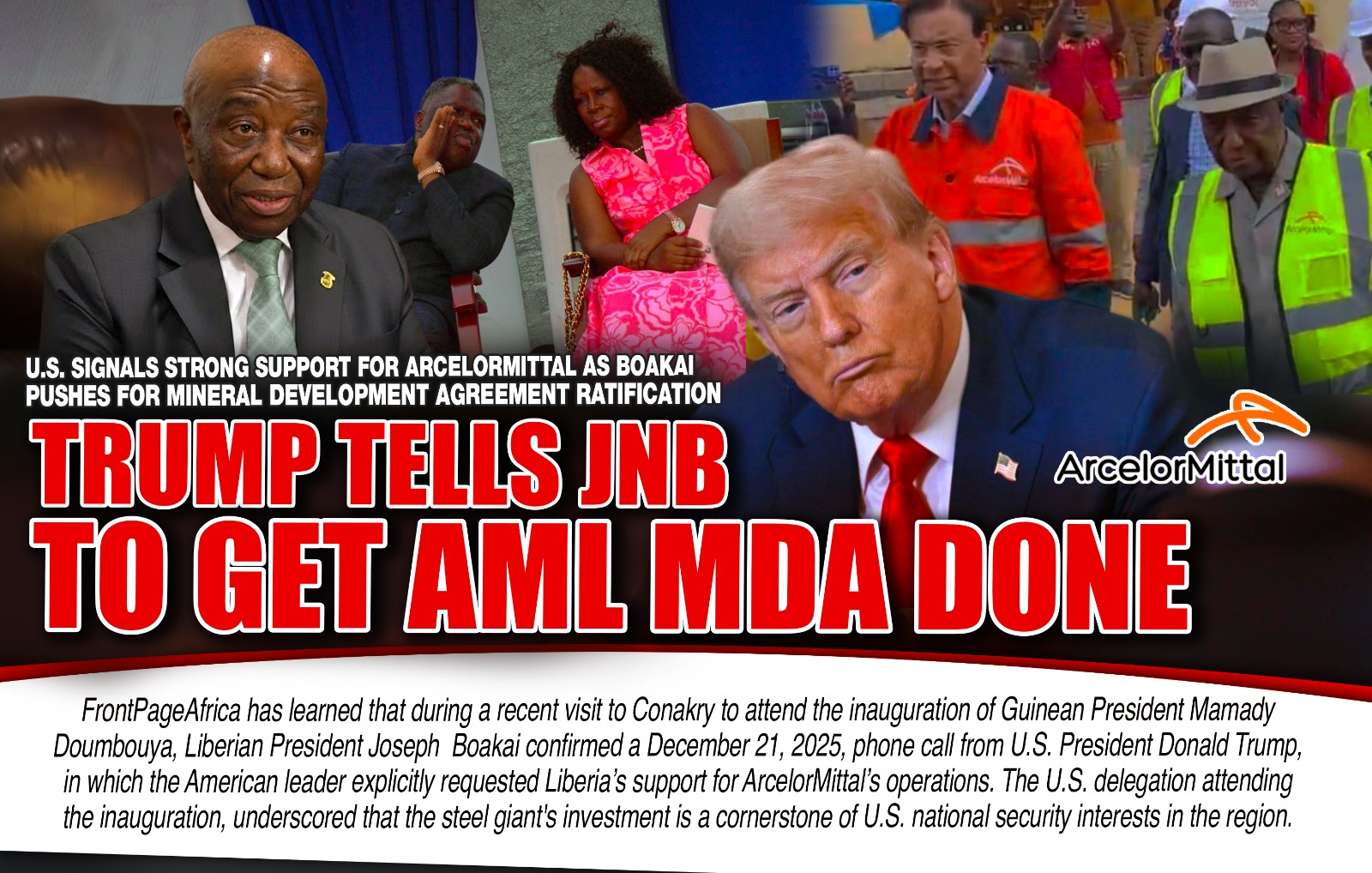
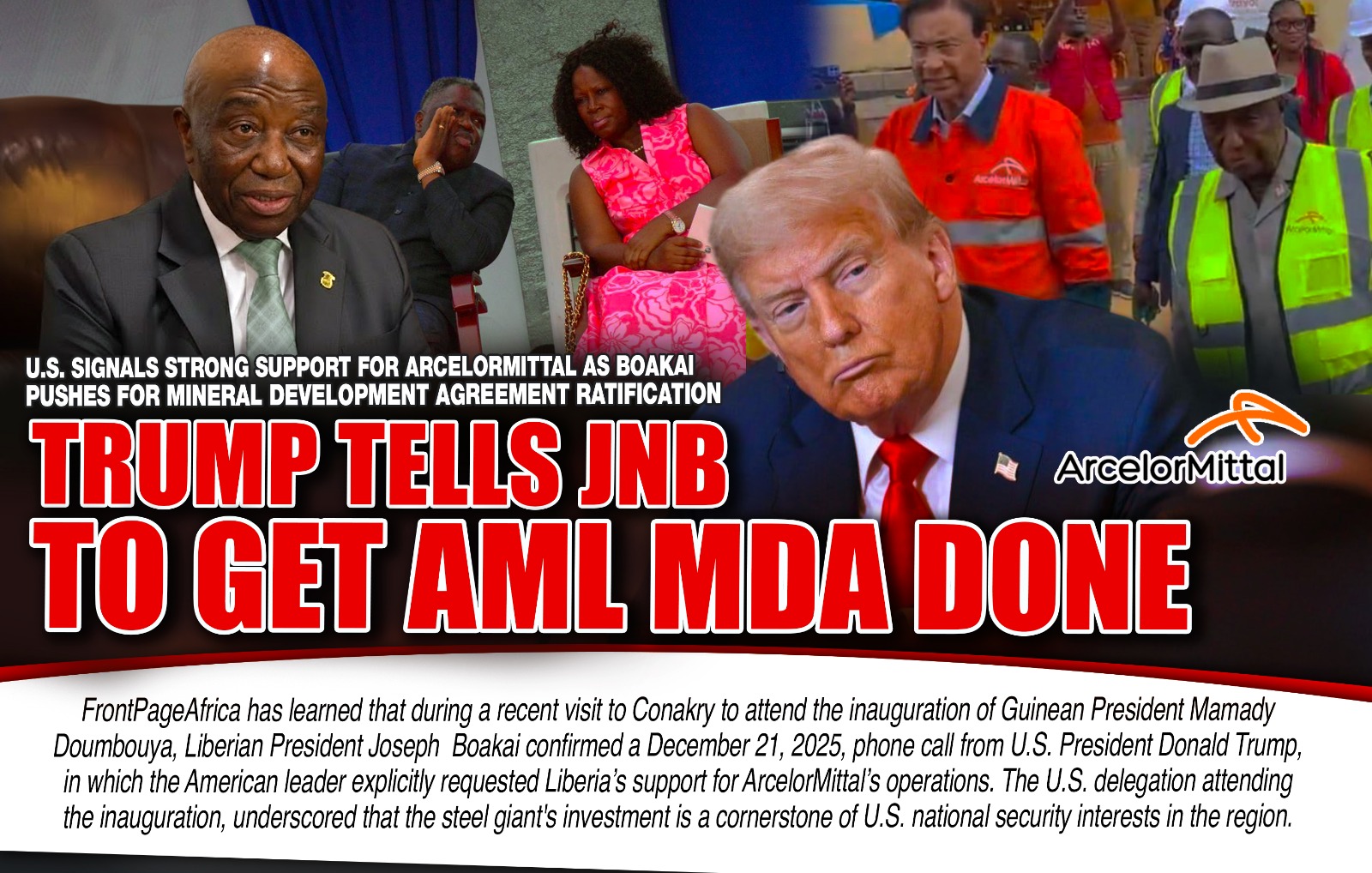
MONROVIA – Following high-level diplomatic talks in neighboring Guinea, President Joseph Nyuma Boakai has issued an urgent appeal to the Liberian Senate to ratify the Third Amendment to the Mineral Development Agreement (MDA) with ArcelorMittal.
By Rodney D Sieh, rodney.sieh@frontpageafricaonline.com
Diplomatic Strategy in Conakry
The domestic push follows a strategic meeting on the margins of Guinean President Mamady Doumbouya’s inauguration on January 17, 2026. President Boakai and the Liberian delegation met with Nicholas Checker, the U.S. State Department’s Senior Bureau Official for African Affairs, and U.S. Chargé d’Affaires Mary Daschbach.
During the discussion, President Boakai confirmed a December 2025 phone call from U.S. President Donald Trump, in which the American leader explicitly requested Liberia’s support for ArcelorMittal’s operations. The U.S. delegation underscored that the steel giant’s investment is a cornerstone of U.S. national security interests in the region.
In response, President Boakai reaffirmed Liberia’s commitment to a multi-user rail and port policy, ensuring that while ArcelorMittal expands, the infrastructure remains open to other commercial interests under a fair, state-regulated framework.
State of the Nation Mandate
Returning to Monrovia for his State of the Nation Address yesterday, January 26, Boakai warned lawmakers that stalling the ArcelorMittal amendment threatens the nation’s economic credibility.
“Delays in passing these measures will weaken the reforms needed for economic growth and institutional integrity,” the President stated, placing the deal at the center of his 2026 legislative agenda.
A Shift in U.S. Policy?
The recent alignment with ArcelorMittal marks a notable development in Liberian foreign policy. For months, speculation suggested that U.S. support—specifically regarding the Millennium Challenge Corporation (MCC)—was tied to the interests of Ivanhoe Atlantic and its proposed “Liberty Corridor.”
However, with the Trump administration’s vocal backing of ArcelorMittal and the recent reaffirmation of Liberia’s eligibility for a second MCC Compact in December, the Boakai administration appears to be successfully balancing multiple major mining interests while prioritizing established U.S. security partners
Legislative Status and Political Undercurrents
The Third Amendment to the AML MDA was overwhelmingly passed by the House of Representatives last week after the plenary endorsed a report from its Joint Committee on Concessions and Investment, Lands, Mines and Energy, and Judiciary. The report followed a public hearing involving members of the Inter-Ministerial Concessions Committee (IMCC), who defended the revised agreement as being in Liberia’s national interest.
The bill has since been forwarded to the Liberian Senate for concurrence.
While a majority of lawmakers reportedly support the amendment, FrontPage Africa has learned that a bloc of senators is allegedly delaying the process. Sources further claim that Senate Pro Tempore Nyonblee Karnga-Lawrence is pushing to link the controversial Port Decentralization Bills to the AML amendment.
The port bills—previously vetoed by President Boakai—were re-passed by the Legislature and sent back to the Executive. Sources say the Pro Tempore may be using the AML agreement as leverage in broader legislative negotiations.
Complicating matters further is an ongoing power struggle between Senate President Pro Tempore Karnga-Lawrence and Vice President Jeremiah Koung, with political observers pointing to maneuvering ahead of the 2029 presidential elections, including competition over access to potential campaign financing streams.
What’s in the Third Amendment
According to the IMCC, the amended agreement delivers significant fiscal, social, and infrastructure benefits, including US$200 million signature bonus, payable within 30 days of the agreement’s effective date, US$5 million annual community development fund for Nimba, Bong, and Grand Bassa counties—up from US$3 million and indexed to inflation, US$200,000 annual infrastructure oversight fee to support monitoring of rail operations by the National Rail Authority, an increased Mining License Fee of US$500,000 annually starting in 2031, up from US$50,000 paid over the previous 25 years, and a , monthly royalty of 4.5% on the FOB Buchanan price, replacing delayed quarterly payments
Jobs and ‘Liberianization’ Commitments
The amendment includes binding provisions aimed at expanding Liberian participation beyond manual labor. The company is expected to increase the Liberian management up to 50% within one year, rising to 75% in five years, and 90% in ten years. At least one Liberian among the top four senior executives (CEO, COO, CFO, CAO) within one year, mandatory hiring preference for qualified Liberians at all levels, and priority for Liberian-owned SMEs, supported by a joint committee to enhance local business participation.
Education and Infrastructure Investments
The agreement also mandates US$500,000 annual training budget for scholarships in geology and mining engineering, establishment of a new AML Vocational Training Center campus in Grand Bassa County, annual funding for the University of Liberia’s Mining and Geology Institute and community colleges, repairs to key bridges, paving of concession roads in Buchanan, and completion of the Sanniquellie–Yekepa road, and full transition to a multi-user rail system, opening access to other mining companies and small-scale miners.
ArcelorMittal Liberia is the country’s largest mining concession and one of the single biggest foreign investors in postwar Liberia. The company, a subsidiary of global steel giant ArcelorMittal, began operations following the signing of a Mineral Development Agreement (MDA) in 2005, which was ratified by the Liberian Legislature in 2006 after the end of Liberia’s civil war.
AML’s concession covers iron ore deposits in Nimba County, with mining activities centered around Yekepa, once home to the former LAMCO operations that collapsed during the civil conflict. The company inherited and rehabilitated critical infrastructure damaged during the war, including the 243-kilometer railway linking Yekepa to the Port of Buchanan in Grand Bassa County, as well as port facilities essential for iron ore exports.
Commercial iron ore exports resumed in 2011, marking a major milestone in Liberia’s economic recovery. Since then, AML has invested over US$2 billion in mining operations, rail and port rehabilitation, power generation, and community development projects, according to company disclosures and government records.
The company employs several thousand Liberians directly and indirectly and remains one of the country’s largest private-sector employers. It also contributes to government revenues through royalties, taxes, land rental fees, social development funds, and other statutory payments.
The post U.S. Signals Strong Support for ArcelorMittal as Boakai Pushes for Mineral Development Agreement Ratification appeared first on FrontPageAfrica.


Leave a Reply