
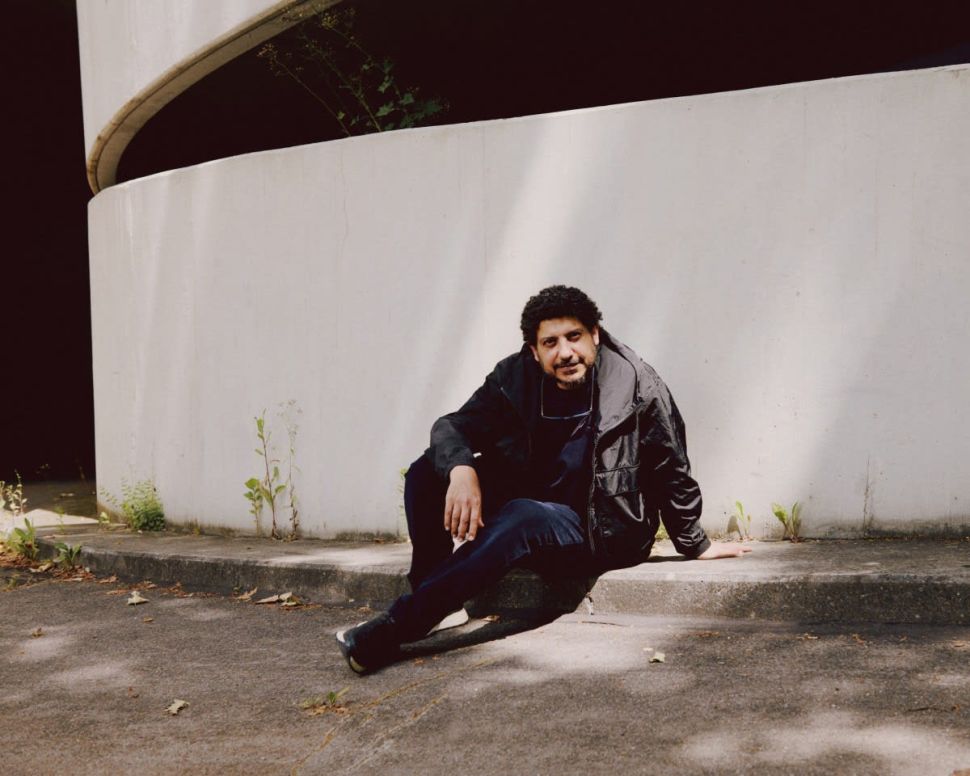
 Wael Shawky seated casually by a curved white wall, wearing a dark jacket and looking toward the camera in soft natural light.” width=”970″ height=”776″ data-caption=’Egyptian-born artist Wael Shawky is the artistic director for the inaugural edition of Art Basel Qatar. <span class=”lazyload media-credit”>Courtesy of Art Basel</span>’>
Over more than four decades, Fire Station in Doha has established itself as a leading contemporary art center not only in Qatar but across the wider region, functioning as a vital platform connecting it to the broader art world. Now, with Wael Shawky at the helm, the institution is repositioning itself as a living laboratory designed to build, shape and expand the multilateral capabilities necessary for the long-term, sustainable development of a cultural art ecosystem. Observer recently spoke with Shawky to understand how Fire Station has been reshaped under his vision, and how this transformation intersects with—and complements—his approach to the inaugural edition of Art Basel Qatar, set to launch in early February.
Originally built in 1982 as Doha’s Civil Defense headquarters, the building was repurposed in 2015 under Qatar Museums as Fire Station: Artist in Residence. One of the first residency programs in the Gulf, it quickly became a key platform for supporting emerging and mid-career artists while connecting them to the international art world. Today, Fire Station continues to operate as a hybrid space for artistic production, exhibitions and education, but with a growing emphasis under Shawky on process, research and critical development over immediate exhibition outcomes.
A laboratory for capabilities-building
In Shawky’s vision, Fire Station is less a conventional institution than a dynamic, multidisciplinary incubator—one designed to formulate a new language and alternative models specific to the region, capable of sustaining the long-term development of its distinctive art ecosystems rather than replicating those of other cultural hubs. “The shift is a conscious move toward positioning it more clearly as an educational space, with a strong focus on contemporary art education,” Shawky says. “The aim is to rethink how education is delivered—not as something standardized or didactic, but as a singular, experimental model that feels genuinely different from existing frameworks.”
The main Artist in Residence (AIR) program was launched in 2015 as a nine-month opportunity for artists living and working in Qatar to develop their practice. In 2021, Fire Station introduced the Ruwad in Residence program, connecting established and local artists at different career stages through mentorship and critique. Alongside this, the institution has hosted international artists through its invitation-only Visiting Artist program designed to foster exchange between local and international practices. Fire Station also launched a Curatorial Residency program in 2020, offering one institutional or independent curator a three-month residency and stipend through an open call, aligned with the AIR program to encourage research and visibility for the Qatari art scene.
Since Shawky took the helm, AIR has evolved into the Arts Intensive Study Programme (AISP), now dedicated to a cohort of 23 emerging international and Qatari artists who participate in a curriculum designed to foster critical thinking, hands-on learning and professional development.
The new AISP program—which combines studio practice, theoretical input and critical discourse—is deliberately intense, Shawky explains, built around a rigorous curriculum that includes practice-based workshops, seminars, group critiques and lectures led by established artists, curators and theorists from around the world. “Experts now don’t come sporadically but have a consistent presence. We aim to run sessions at least three days a week. That’s why I describe it as a new educational format: it’s demanding, immersive and sustained, and you can really see the results.”

This is AISP’s pilot year, but it already reflects the program’s foundational principles. “We have participants from 14 nationalities, with half coming from the region, alongside artists from India, Nepal, Pakistan, China, the U.K., the U.S., France, Bahrain, Egypt and Qatar. This diversity is central to what we’re trying to build,” Shawky says. That approach closely aligns with Qatar Museums’ ambition to operate as a global center for artistic innovation and cultural exchange. “We’re now thinking of this place as a hub that brings together people from different cultures, languages and backgrounds. The aim is to create an environment where those encounters can generate a shared intellectual discourse. Over the course of the year, and then year after year, that discourse can begin to crystallize into something new: a new language, shaped collectively through exchange, study and practice.”
At the core of Shawky’s vision for Fire Station is an attempt to redefine how art can be taught. “The belief underpinning the program is that artistic knowledge does not circulate only vertically, from master to student, but horizontally—through sustained discussion, shared inquiry and continuous exchange between participants, and between students and the curators, philosophers, artists and architects who regularly enter the space,” he reflects. “In this sense, education here is not a curriculum to be delivered, but a living process, shaped collectively through dialogue, proximity and time.”
Each cohort of residents develops its own exhibitions, with the first three set to open in parallel with Art Basel Qatar. “These exhibitions are part of the educational ecosystem,” Shawky points out. “They’re produced internally, offering participants the opportunity to engage directly with curatorial processes and exhibition-making.” For him, this approach is the only way to build long-term engagement and capacity within the local community while supporting the emergence of the next generation of artists, curators and cultural professionals, and encouraging greater fluidity between roles.
“Today, artists cannot only be producers of objects. They are becoming cultural producers, cultural activators,” he argues. “Their roles are more fluid, and I see this clearly in the younger generation I’m working with: they move between making, thinking, organizing and teaching. The real challenge is whether the art market can evolve fast enough to keep pace with this shift, because the market often pulls artists back into older, more restrictive roles.”
Wael Shawky embodies this expanded model: his practice, and his broader role within the art world, has consistently unfolded across multiple registers: artist, filmmaker, storyteller, institution-builder and educator. His long-standing engagement with art education and cultural production is evident in initiatives such as MASS Alexandria, the independent art school he founded in 2010, where theory, research and collective discussion were positioned not as supplements to artistic practice, but as its driving engines.
“There is no single frame for what an artist should be. Once art becomes framed too rigidly, it stops being art,” he explains. “The same goes for education. You cannot really ‘teach’ art in a closed system. Learning art means constantly chasing what you don’t yet know.” The decision to move away from a residency-centered model is not a rejection of residencies themselves, Shawky clarifies, but an acknowledgment that, at this moment in Qatar, a different kind of infrastructure is required. “The focus has shifted decisively toward education and building the conditions in which artistic thinking can be developed, articulated and sustained over time.”

This shift reflects Shawky’s belief that sustainable and thriving cultural ecosystems are not built through short-term investment, but through sustained institutional and educational commitment, critical frameworks and intellectual continuity. Only in this way can culture function as foundational infrastructure, gradually generating conditions for social innovation, education and long-term civic capacity-building. Culture, in this sense, does not merely attract outside talent or cultural tourism but activates internal capacities, enabling social mobility, resilience and distinctive forms of cultural production. “There is a commitment to fostering the emergence of new, unique and deeply personal artistic languages,” Shawky emphasizes. “This is not about importing models wholesale, but about creating a space where something can genuinely emerge from the region itself.”
At the same time, he emphasizes the importance of outreach and public programming. “This is the one element that remains closest to the previous structure, but even here, we are trying to develop it further.” Workshops with the public and with children remain central, but his ambition is to push these activities beyond craft-based engagement alone. “I want to introduce more content, more information and more theoretical thinking into these workshops, so they become spaces of reflection as well as making.”
This focus on the local community is particularly urgent given that many cultural institutions—especially newer ones in the region—are oriented primarily toward the international art world. “While global dialogue matters, I also want Fire Station to speak directly to the local community,” Shawky says. “People here are genuinely curious and deeply interested in art, and Fire Station sits at the heart of the city. It is accessible, visible and embedded in everyday life.” That proximity creates a responsibility to engage the local public not as an afterthought but as a central institutional mandate.
The challenge, he acknowledges, is holding both positions at once: maintaining a demanding, deeply professional program while also cultivating an open, generous and accessible public sphere. “The professional path must remain uncompromising,” he says, “but the public program must remain open.”
Strategically positioned between the Museum of Islamic Art and the National Museum of Qatar, within the rapidly expanding cultural ecosystem of Qatar and the Gulf more broadly, Fire Station functions as a critical bridge between heritage, national narrative and contemporary practice. In doing so, it effectively compensates for the still-limited density of grassroots art schools, galleries and independent organizations that elsewhere provide essential spaces for experimentation, research, professionalization and international exchange while also operating as a key point of mediation between the local community and the new arrival of a global art scene set to land with Art Basel Qatar.
Art Basel Qatar and local ecosystem growth
These same concerns shape Shawky’s vision for the inaugural edition of Art Basel Qatar, with 87 galleries set to mount booths at the M7 in Doha Design District, nearly half from the region. “This reflects the same logic we are applying at Fire Station,” he explains. “It’s about amplifying voices from the region without isolating ourselves from the world. We need to remain grounded locally while staying in dialogue globally.”
When Art Basel approached him to lead the Qatar edition—the first time an artist has taken on such a role—his central concern was the sustainability of artistic careers in a region where institutional infrastructure is rapidly expanding, yet the professional art market remains fragile. “It raised a fundamental question: how do we convince a young artist from Bahrain, Saudi Arabia, Egypt, Qatar, Pakistan or India that art can be a real, sustainable profession?” he asks. “Without infrastructure, without a functioning ecosystem, that’s incredibly difficult. It’s really that simple.”

For Shawky, Art Basel Qatar offered an opportunity to complete a cycle, opening a necessary conversation about the role of the artist within the professional market itself. Too often, he argues, artworks are displaced—removed from their narrative and conceptual context and reinserted into purely commercial frameworks.
“Works are placed next to other works with no conceptual relationship, simply because they fit a booth or a market strategy,” he says. “That’s one of the core tensions of the art fair model: it’s powerful, but for artists, the loss of narrative coherence can be profound.” To counter this, the first edition adopts a one-artist-per-gallery format, effectively transforming booths into micro solo exhibitions that preserve context and restore a degree of curatorial integrity, even within a market-driven environment.
At the same time, public engagement is equally crucial to ensuring that Art Basel Qatar does not land just as a detached global brand. A dedicated public program will unfold across the city, beginning on February 5, with major events at M7 and other venues, alongside public artworks commissioned specifically for Doha. “I invited nine artists to create public works in open spaces,” Shawky notes, “so the experience is not confined to institutional walls.”
In the days that follow, Shawky plans to spend time at the fair itself, guiding visitors, speaking directly with the public and contextualizing the works. That mediation, he argues, is essential to closing the gap between artists, institutions, markets and audiences.
Throughout art week, Fire Station will serve as an anchoring site of mediation. On Wednesday, February 4, the second day of the fair, it will host a series of public talks, exhibition walkthroughs and conversations with international artists and curators. “These talks are intentionally open to everyone,” Shawky says. “One of them is especially important to me: it’s about how leading artists and thinkers pass knowledge to a younger generation, and how that younger generation, in turn, begins to form a new language—one they may not yet fully articulate, but are actively searching for.”
The Gulf as a platform to test new models
Throughout the conversation, Shawky’s insistence on a “new language” is anchored in his conviction that the Gulf can function as a privileged platform for envisioning new cultural models. Contrary to persistent stereotypes, the region is anything but new. It carries ancient civilizations, layered belief systems and long, complex histories that extend far beyond the framework of modern nation-states. The Gulf itself holds deep prehistoric, mercantile and cultural trajectories that are often overlooked when contemporary international narratives reduce it to the shorthand of “rising economies.”
For Shawky, the Gulf and the wider Middle Eastern region embody humanity’s perpetual drive toward transformation, a theme deeply embedded in its history and culture, and one that also informs Art Basel’s curatorial framing of “Becoming.”

Across civilizations, he argues, societies have repeatedly sought to become “higher” and “better,” reinventing themselves through shifts in ideology, belief systems, political structures and modes of life—from nomadism to agriculture, from agrarian societies to urbanism. The religions that emerged from this region, too, have often carried the same aspirational logic, promising transcendence, elevation and moral progress. Within this long historical arc, the Gulf—and Doha in particular—emerges as a contemporary site where these forces are once again intensified, accelerated and made visible. “When we talk about the region, we’re not talking about something new—these are ancient cultures, ancient histories, layered civilizations. But what’s changing is the scale, the measurement, the model,” he argues. “For me, the Gulf becomes a kind of metaphor for this ongoing human condition. It represents this desire to transform, to reinvent systems, to move forward.”
In a moment of broader geopolitical, social and historical realignment, when Western models are increasingly showing signs of fracture, the Gulf is a testing ground for alternative cultural paradigms. “For a long time, European models were the default measure of success or legitimacy. Now, those measurements are shifting. New regional models are emerging, and we need time to understand them properly. We need time to develop new scales, new criteria, new ways of reading what is happening,” Shawky emphasizes. While much of the Western world continues to struggle with questions of inclusion, migration and plural voices, he observes that the Gulf is increasingly positioning itself as a hub for precisely that kind of multiplicity. “Here in Doha, I’m constantly involved in meetings and conversations that include voices from Pakistan, Uzbekistan, India, China and across the Arab world. This, for me, is how culture should function today,” he says. “I see this region as a platform to experiment with new cultural models that are not simply European or American, but genuinely plural. This is not about isolation. It’s about balance and dialogue.”
More Arts Interviews
-
Henrique Faria On Venezuelan Art and Cultural Persistence
-
Adrian Parr’s Intimate Response to an Unthinkable World
-
Henrique Faria On Venezuelan Art and Cultural Persistence
-
How Kay Matschullat’s MAX Is Rewriting the Language of Performance in the Age of Techno Art
-
How a Kansas City Mermaid Became Will Cotton’s Muse
Observer


Leave a Reply