
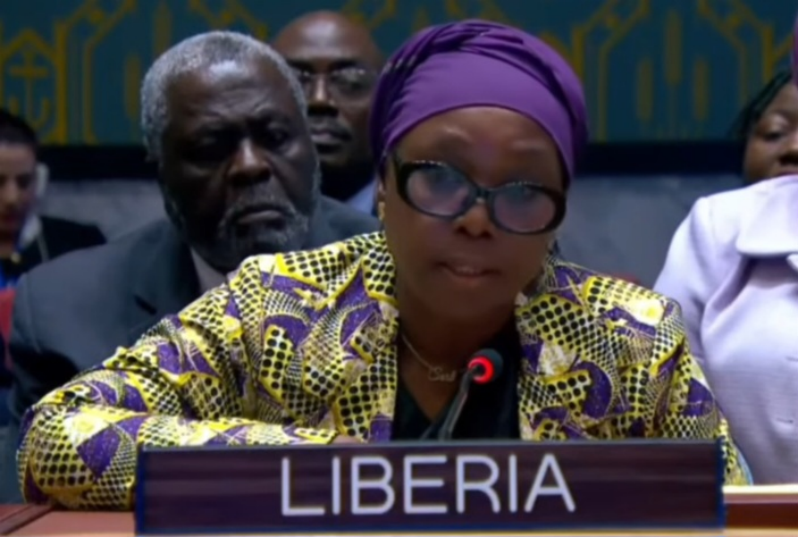
Monrovia– The Minister of Foreign Affairs, Sara Beysolow Nyanti, has appealed at the United Nations Security Council, stating that the Middle East conflict is not a distant crisis but a defining test of whether the Council can “shape outcomes rather than merely catalogue suffering.”
By Jaheim T. Tumu-jaheim.tumu@frontpageafricaonline.com
Nyanti, addressing a high-level debate convened by the Somali Presidency, said Liberia’s own history of civil war offers lessons for the region.
“Liberia’s own experience reminds us that silencing guns matters, but peace does not come from silence of the guns alone. It comes from choices, choices made early, deliberately, and sustained over time,” she declared.
Addressing the protracted Israeli-Palestinian conflict, Nyanti said, “Liberia continues to support a negotiated two-state solution consistent with relevant Security Council resolutions. Security that lacks political legitimacy cannot endure.”
The Israeli-Palestinian conflict is one of the world’s longest-running disputes, driven by competing claims over land, identity, and sovereignty. Since Hamas took control of Gaza in 2007, repeated wars with Israel—marked by cycles of rocket attacks and airstrikes—have caused widespread civilian devastation.
Recent attack: In the latest flare-up, Israeli airstrikes struck multiple areas of Gaza despite an ongoing ceasefire, killing dozens of Palestinians—including women and children—and hitting homes and security sites in Gaza City and Khan Younis. Israel said the strikes were aimed at militants it said breached the truce, while critics called the attacks a violation of the ceasefire and warned of worsening humanitarian suffering.
She added: “Crisis management, however necessary, cannot substitute for a genuine peace process. Force can dominate a moment, but only justice can shape a future. If force worked, we would not be here having this debate.”
Nyanti extended Liberia’s concern to other flashpoints in the region, On Lebanon, she recalled Resolution 1701 and reaffirmed support for UNIFIL’s stabilizing role.
On Syria, she noted that humanitarian suffering continues amid political paralysis, stressing that Resolution 2254 remains the agreed framework for sustainable peace, while welcoming fragile steps toward de-escalation: “Dialogue remains the only path that does not anymore deaths and destruction.”
Nyanti envisioned a future where dignity and justice replace despair: “Peace in the Middle East cannot be defined simply by what ends. It must be defined by what begins. Dignity, justice, and the freedom for people to build ordinary lives.”
She painted a hopeful picture of coexistence: “It must offer a future where Jews and Palestinians, Christians and Muslims, Arabs and non-Arabs can live not only side by side, but together working in the same hospitals, trading in the same markets, studying in the same universities, protecting shared water sources, building businesses, and competing in ideas rather than arms.”
Nyanti outlined expanded humanitarian corridors into Gaza and all conflict zones, support for confidence-building measures facilitated by UN peace-building and regional partners.
She explained that sustained diplomatic engagement to prevent collapse of current openings, echoing the collapse of past negotiations, where fragile progress was lost to mistrust and violence, protection of children from recruitment in conflicts and shielding of schools and hospitals from attacks.
“Liberia stands ready to work with all council members for sustainable peace in the Middle East,” she declared.
The Liberian Foreign Minister placed children at the center of her remarks, describing them as the most unforgivable victims of war.
“Some babies die while trying to nurse from mothers whose bodies have nothing left to give. They die not from rare diseases or unavoidable fate, but from hunger, blockade, displacement, and decisions made far from their cries,” she said.
She contrasted the lives of children in conflict zones with those elsewhere: “While children elsewhere worry about exams, football matches, music, friendships, and what they might become in the future, children in the Middle East learn how to stay safe during explosions and the best route to take to find food.”
Nyanti warned that this is not only a moral failure but a strategic catastrophe. “It recycles violence, enmity, and hate.”
Nyanti acknowledged recent diplomatic efforts by Qatar, Egypt, the United States, and other regional actors to reduce violence and improve humanitarian access in Gaza but cautioned against abandoning openings for peace.
“Progress, however, is fragile, but progress matters. Let’s be clear, this momentum must be sustained,” Nyanti emphasized.
Adding, “History shows that diplomatic openings will close inevitably, not because they are imperfect, but because they are abandoned.”
The post In Israel-Palestine Conflict, Foreign Minister Nyanti Reaffirms Liberia’s Support for Two-State Solution appeared first on FrontPageAfrica.


Leave a Reply