
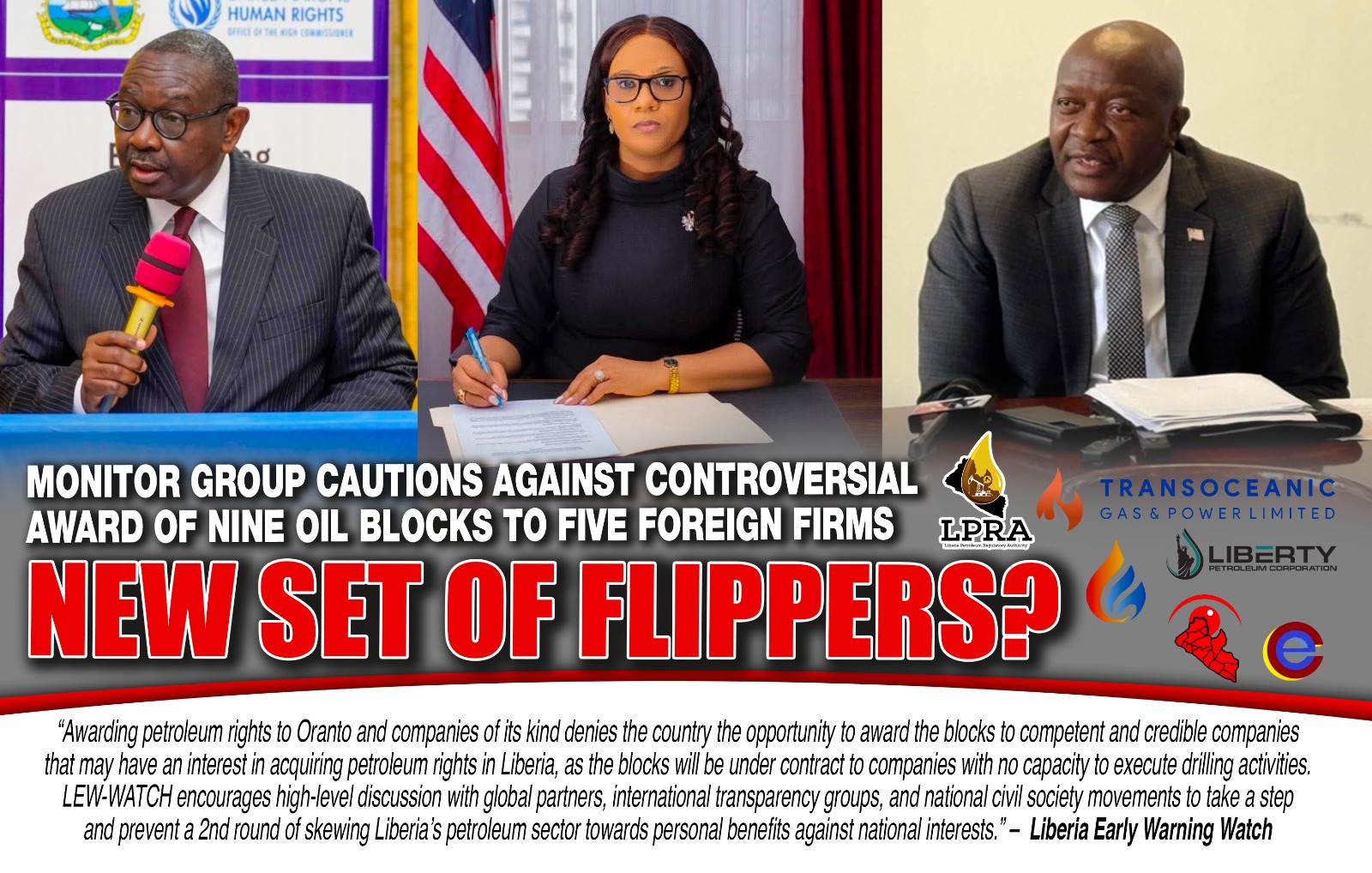
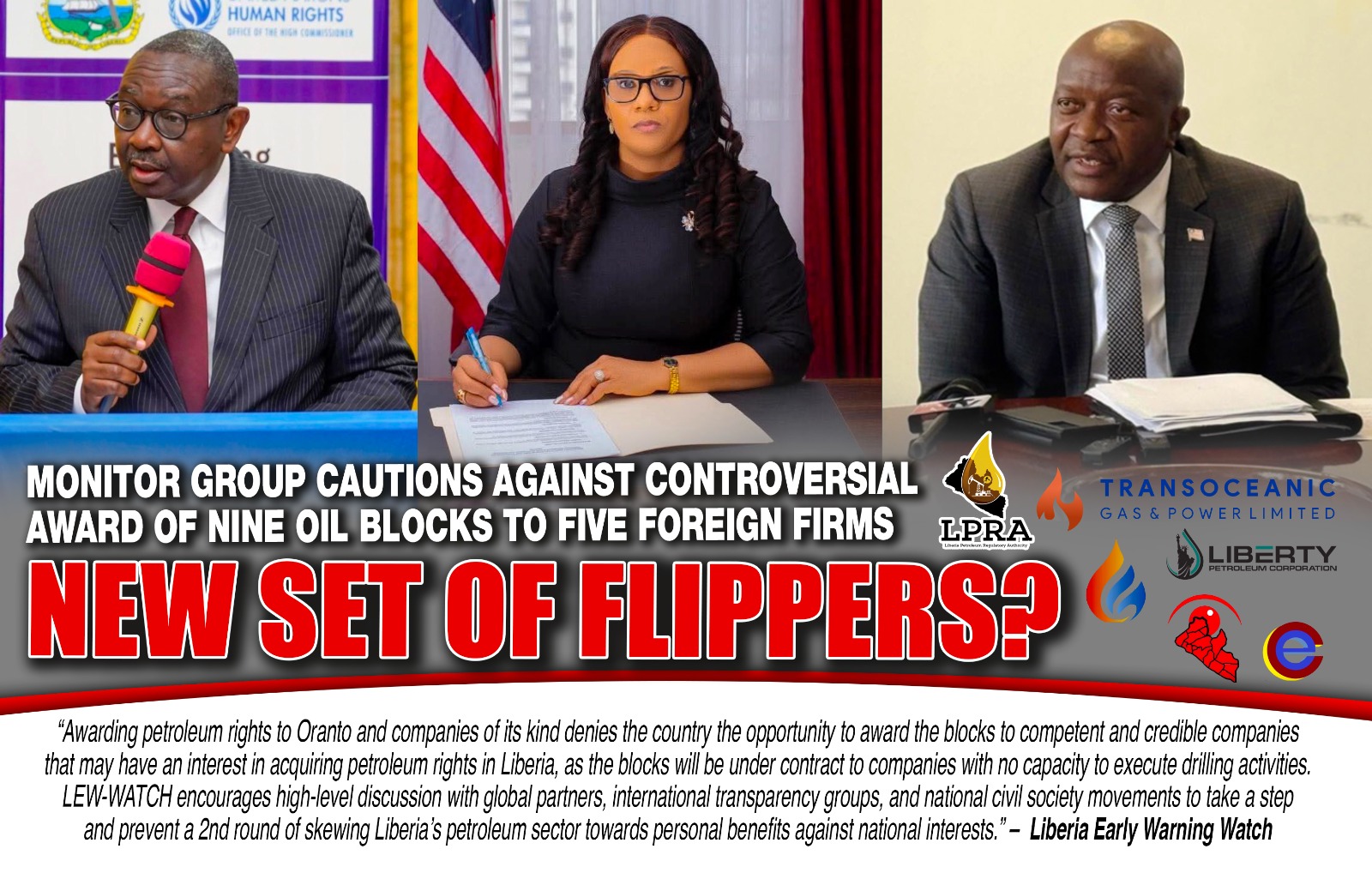
MONROVIA – Liberia’s long-running quest to transition from an oil-producing hopeful to an actual producer has again come under scrutiny, following reports that the government is preparing to award nine offshore petroleum blocks to five foreign firms under circumstances critics describe as controversial.
By Gerald C. Koinyeneh, gerald.koinyeneh@frontpageafricaonline.com
While the government has pledged transparency in its renewed push to revive the offshore petroleum sector, civil society actors are questioning the credibility and technical capacity of the companies reportedly selected for the exploration contracts.
Liberia Early Warning Watch (LEW-WATCH), a civil society monitoring group, is the latest to raise the alarm. In a detailed report, the watchdog warned that the planned awards could undermine transparency and Liberia’s long-term national interest in the petroleum sector.
According to LEW-WATCH, Liberia’s oil industry is still grappling with unresolved concerns surrounding the award of Blocks LB-15, LB-16, LB-22, and LB-24 to Atlas Oranto Petroleum Liberia Limited. The group noted that Oranto’s agreement in Senegal was reportedly terminated for failure to comply with contractual obligations. The company’s owner, Prince Arthur Ize, has also faced scrutiny in other jurisdictions over alleged political connections, notably with Venezuela’s former President Nicolas Maduro.
LEW-WATCH further alleged that senior government officials — including the Ministers of Finance and Justice – Augustine Kpehe Ngafuan and Cllr. N. Oswald Tweh, the head of the Liberia Petroleum Regulatory Agency (LPRA), are poised to sign new Production Sharing Contracts (PSCs) with companies it says bear similarities to Oranto in terms of technical capacity and operational track record.
The concerns come as the government intensifies efforts to revive Liberia’s offshore petroleum sector, which has remained largely dormant despite decades of licensing agreements. Critics argue that without stringent due diligence, clear technical benchmarks, and full public disclosure, the sector risks being dominated by politically connected intermediaries rather than serious exploration companies.
Under Liberia’s Petroleum Law, the LPRA leads and coordinates negotiations for petroleum agreements, the Ministry of Finance and Development Planning (MFDP) evaluates the financial terms, the Ministry of Justice ensures legal compliance, and the Liberia Revenue Authority is responsible for safeguarding the country’s tax interests.
When contacted for comment, the Ministry of Finance said through its communications department that it would respond to FrontPage Africa’s inquiry in due course. The LPRA and the Ministry of Justice did not respond to emailed requests for comment up to the time of publication.
Companies Under Scrutiny
The companies reportedly earmarked for the oil blocks include Binad Oil and Gas Services of Nigeria (Block 8), Tarrock Integrated Oil & Gas of Nigeria (Block 9), Cabral Energy LLC of the United States (Blocks 2, 3, and 4), Transoceanic Energy Group of Nigeria (Block 27), and Liberty Petroleum of the United States (Block 32).
LEW-WATCH said its review of corporate records shows that Binad Oil and Gas Services Ltd is primarily a logistics and general merchandise supplier to oil and gas companies, rather than an exploration firm. According to its website, Binad’s core business includes equipment supply, haulage services, water processing systems, and general contracting.
The watchdog argued that such a business profile does not meet the technical requirements for offshore oil exploration. It also alleged that Binad’s major shareholders are longtime associates of Prince Arthur Ize.
Cabral Energy, a privately held company headquartered in Houston, Texas, describes itself as an oil and gas firm focused on exploration and development. However, LEW-WATCH said its findings suggest the company is an early-stage entity largely engaged in data analysis, operational consulting, and project management, with no verifiable record of offshore drilling operations.
Transoceanic Energy Group, registered in Nigeria in September 2023, focuses primarily on liquefied natural gas, according to publicly available records. LEW-WATCH said it could not independently verify the company’s claims of having an operational exploration and production subsidiary.
The watchdog said it was unable to find sufficient publicly available information on Tarrock Integrated Oil & Gas. FPA did not find Tarrock Oil & Gas after a thorough search.
Liberty Petroleum, founded in 1997, previously held an exploration license in Liberia through a partnership with a local firm owned by the late McDonald Wento. That agreement failed to take effect after fiscal requirements were not met. LEW-WATCH acknowledged, however, that Liberty Petroleum has since acquired exploration licenses elsewhere, including in Somalia, and has participated in drilling programs through partnerships.
LEW-WATCH Warning
In a strongly worded statement shared with FrontPage Africa, LEW-WATCH cautioned that awarding petroleum rights to companies lacking technical and financial capacity could repeat past mistakes that have stalled Liberia’s oil ambitions.
“Awarding petroleum rights to Oranto and companies of its kind denies the country the opportunity to award the blocks to competent and credible companies that may have an interest in acquiring petroleum rights in Liberia,” the group said. “These blocks will be under contract to companies with no capacity to execute drilling activities.”
The watchdog warned that such arrangements risk turning Liberia’s oil blocks into speculative assets controlled by “flippers” — firms that acquire licenses not to develop resources but to trade them for profit.
“LEW-WATCH encourages high-level discussions with global partners, international transparency groups, and national civil society movements to prevent a second round of skewing Liberia’s petroleum sector toward personal benefits against national interests,” the statement added.
Civil society organizations have repeatedly called for competitive bidding, full disclosure of petroleum contracts, and strict enforcement of technical and financial requirements to ensure Liberia’s natural resources serve the broader public interest.
How did we get here?
Liberia’s petroleum exploration history dates back to the 1950s, when early geological surveys suggested the presence of hydrocarbons along the country’s offshore basin. Initial exploration efforts were limited, largely due to inadequate technology and low investment.
Interest intensified in the late 1970s and early 1980s as global oil prices rose. In 1978, Chevron made Liberia’s first confirmed offshore oil discovery, validating the presence of hydrocarbons. However, the find was never developed into commercial production due to technical challenges, high costs, and unfavorable market conditions.
Liberia’s civil war (1989–2003) brought all meaningful petroleum activities to a standstill. Contracts lapsed, infrastructure collapsed, and investor confidence evaporated. By the end of the conflict, the sector was dormant and outdated.
Following the restoration of peace, the government sought to revive the industry by passing a new Petroleum Law in 2005. Between 2007 and 2013, several offshore blocks were awarded to international companies, including Chevron, ExxonMobil, African Petroleum, and Oranto Petroleum. Liberia was grouped within the promising West African Transform Margin, alongside Ghana and Côte d’Ivoire, raising expectations after Ghana’s Jubilee Field discovery in 2007.
Despite extensive seismic surveys and exploratory drilling, none of Liberia’s wells resulted in a commercially viable discovery. By the mid-2010s, falling global oil prices and disappointing results prompted major companies such as ExxonMobil and Chevron to exit.
To strengthen oversight, Liberia established the Liberia Petroleum Regulatory Authority (LPRA) to regulate and supervise petroleum activities. In recent years, new bidding rounds and contract restructuring efforts have reignited public debate, with civil society groups warning that weak due diligence and non-competitive awards risk locking Liberia’s oil blocks into the hands of non-producing firms.
The post Liberia: Monitor Group Cautions Against Controversial Award of Nine Oil Blocks to Five Foreign Firms appeared first on FrontPageAfrica.


Leave a Reply