

Since ancient times, theater has served as a mirror for society, with the stage acting as a site of representation and reflection where communities confront the forces shaping their realities, from politics and power to identity and belonging. In an era when our relationship to reality is increasingly mediated by devices that filter, support and structure perception and communication, the theatrical stage and performative space have emerged as natural platforms for experimentation across body, language, gesture and technology. Yet, traditional theater has long resisted this mediatization, clinging to a conservative posture that, for years, also defined much of the museum world, rejecting technology and digital expression as though they belonged solely to entertainment or spectacle. However, that resistance is beginning to erode. Theater and performance are opening new spaces for presentation and exchange within the expanding realms of technology and science.
One clear example of this shift is Media Art Xploration (MAX), a creative laboratory, production studio and incubator dedicated to discovering, supporting and producing ambitious artistic projects that merge scientific inquiry with cutting-edge technology to reflect the pulse of contemporary culture. Operating at the intersection of art, science and technology, MAX places particular emphasis on performance, theater and multimedia art, catalyzing live and immersive experiences developed by collaborative teams of artists, scientists and creative technologists. Through its open-call fellowship program, MAXMachina functions as a true creative partner, offering financial, logistical and community support to ensure each selected group has the resources needed to realize its vision fully.
Following MAX’s recent presentations in New York, including the immersive sound experience Sonic Sunset, which debuted at the Museum of the Moving Image and the public showing of the first works by its MAXMachina fellows this November at MiTU580, Observer spoke with the genius ex machina behind the organization, Kay Matschullat, executive and producing director of MAX: Media Art Xploration.

Matschullat prefers to describe MAX as a laboratory—something that can function as both a production studio and an incubator, much like startup accelerators in the sciences. “Sometimes we’re the ones who catalyze the piece—we come up with the idea, gather the group and set things in motion. Other times, the piece comes to us already formed and we step in to support it, bringing collaborators together or working with collectives that already exist,” she explains. “It’s really a kind of scientific laboratory in that sense.”
With an extensive background in performance, Matschullat has directed premieres of plays by Nobel Prize-winning playwright Derek Walcott, Pulitzer Prize-winning playwright Ariel Dorfman and Václav Havel, among others.
After decades in the theater, however, she began to feel the form was stagnating. “I began to feel like we were turning into an antique store. I wanted to find a way to evolve,” she recalls. While collaborating with engineers in Silicon Valley, she created a platform to make play development more fluid and adaptable, particularly as economic pressures continued to compress rehearsal time.
What struck her most was the resistance she encountered within the theater world and the parallel lack of understanding among engineers when it came to performance. “These two worlds didn’t speak the same language and I wanted to bring them together,” she says. For Matschullat, the zeitgeist of our time is defined by science and technology, shaping cultural consciousness much as religion did during the Renaissance. “When I ran into that resistance, I realized how important this conversation was. That’s when we founded the organization. We held a proof-of-concept festival in San Francisco and then eventually moved back to New York.”
Since founding MAXlive in 2014, Matschullat has produced a series of multi-venue biennial festivals, including MAXlive 2019: A Space Festival, which focused on collaborations between scientists and performers; MAXlive 2021: The Neuroverse, which examined intelligence and applications of A.I. in performance; and MAXlive 2023: Where Is My Body, which explored the changing nature of embodiment through dance, music and immersive performance. Partners include Carnegie Hall, The Exploratorium, MASS MoCA, National Sawdust, New York Live Arts, the Museum of Science (Boston), the California Academy of Sciences and the Highland Center for the Arts.

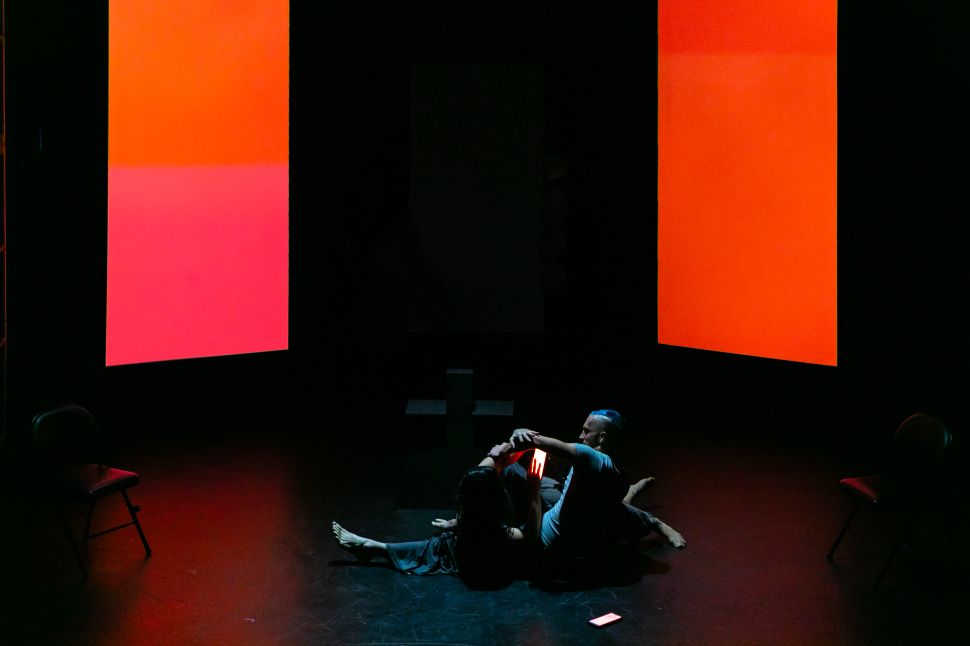
The performance The Syntax of Undoing by Raymond Pinto and Team Rolfes, presented at MiTU580 in November, exemplified MAX’s experimental approach—testing new multimedia collaborations and engaging audiences early in the creative process. “Even at that early stage, it’s really important for us to put the work in front of an audience,” Matschullat says. “You need that time in the laboratory to experiment, but you also need that exchange with the audience.”
On stage, different worlds collided as the performance reimagined The Tempest, layering dance, music and real-time visual rendering into a single choreography that blurred distinctions between stage and screen, human and digital body. With Raymond Pinto embodying both Ariel and Caliban, his dual role bridged live dance and digital space, blending choreography with improvised cello by musician Matthew Jamal and responsive visual environments by Team Rolfes. Three distinct layers—the musician, the virtual world and Pinto’s dance—merged into a new hybrid dimension.
MAX deliberately cultivates this balance of collaboration and friction as a driver of creative progress. During the performance, physical and virtual worlds intertwined: the musician, the virtual environment and Pinto’s choreography each generated their own dimension and their convergence produced a new hybrid space altogether. When one of Pinto’s motion sensors malfunctioned mid-performance, it became part of the work, underscoring the friction and fragility inherent in live technology. “The virtual world-building is one part of it, but the live element brings friction, spontaneity and possibility,” Matschullat reflects. “That’s what draws people in—the engagement with multiple layers of reality, which feels so natural to us now.”
This dynamic of embodiment and disruption sits at the core of MAX’s inquiry. “It’s fascinating how time can be manipulated in these live, hybrid realms,” Matschullat says. “On stage, time and space merge. But it’s also about the body and how far it can extend beyond the physical.” In this sense, digital embodiment operates not only as a technical approach but also as an aesthetic strategy, increasingly used to heighten awareness of how technology mediates everyday sensory experiences. “Everything today is mediated by technology,” she adds. “But ultimately, it’s still about the people in the room—their connection, their use of technology to push artistic expression forward and their questioning of what it is and where it’s taking us. It’s about the uncertainty, instability and fragility we all feel in the face of it.”
A natural next step in MAX’s inquiry is artificial intelligence. The organization has already explored it through projects such as Annie Dorsen’s Prometheus Firebringer and Jurassic Park, a satirical reimagining directed by an A.I. system that cast audience members live. “People were far more willing to take direction from a machine than from a human,” Matschullat laughs. The result was both humorous and profound, a poetic reflection on consciousness and authorship, mediated by the artists yet sparked by the machine.

She emphasizes that despite these projects, A.I. use remains deeply shaped by human input. Ongoing collaborations with A.I. scientists, such as Tom Griffiths at Princeton and research teams at NYU, examine the evolving interface between humans and machines, a frontier even experts admit they do not fully understand. “When I first started talking with them five or six years ago, they were far more cautious. Now their curiosity has widened,” she says. “They’re generous with their time because they’re genuinely interested in what these collaborations might reveal.” For Matschullat, A.I. is not something to champion or resist but to interrogate, both as a tool and as a medium for exploring creativity, empathy and the limits of human experience.
A significant part of MAX’s mission lies in securing funding and partnerships to make such complex productions possible. “We function both as producers and artistic directors,” she explains. “We guide the artists creatively, but we also support them on the production side.” Having spent a lifetime in the performing arts, she is acutely aware of how difficult it has become to find spaces that support artists both aesthetically and financially, especially for those working at the intersection of art, science and technology, where timelines are longer, and systems of production diverge from traditional institutional models.
From the outset, MAX’s structure has been intentionally nomadic, operating without a fixed venue and instead partnering with existing ones. Like a theater company whose productions travel, the organization concentrates its resources on programming while relying on venue partners for physical infrastructure.
Premiered at the Museum of the Moving Image during Climate Week, Sonic Sunset, one of MAX’s most ambitious productions, will travel in an expanded form to the Boston Museum of Science in January. Conceived in collaboration with scientists and bioacousticians studying endangered ecosystems, the work transforms raw data into an immersive soundscape that enables audiences to experience climate change firsthand through audio. Directed by Matschullat with Emmy Award-winning sound designer and composer Nick Ryan and projection designer David Bengali, the piece draws on more than a decade of field recordings from sub-Arctic waters, the rainforests of Borneo and India’s Western Ghats. Using 63-channel spatial audio technology, it reconstructs the dimensionality and presence of these ecosystems as though unfolding around the listener. “People talk about seeing climate change,” Matschullat says. “But in this piece, you actually hear it happen.”
For her, Sonic Sunset stands as one of MAX’s most rewarding interdisciplinary projects, demonstrating how art can illuminate science not merely as data but as shared cultural experience. She notes that museums have become increasingly receptive to media and digital art since the pandemic, embracing immersive and time-based works more readily. Yet because museums rarely produce such pieces in-house, incubators like MAX play a crucial role in bridging that gap. “It’s an interesting moment,” Matschullat observes. “Durational pieces ask something different of audiences. In museums, people wander in and out, so the challenge and the opportunity is to hold their attention long enough to draw them into the work.”

If the art and theater worlds once considered themselves separate, they are now converging through performance, media-based and immersive practices. “What’s emerging is much closer to theater in its complexity,” she says. “It involves choreography, light, music and movement and it’s far more collaborative, which is what I love about the laboratory model. These teams create worlds that couldn’t exist without everyone’s combined imagination.”
Working alongside scientists also opens new pathways. Research institutions increasingly invite artists into collaboration, drawing audiences that are curious, interdisciplinary and open. “Both scientists and artists feel a deep sense of reward in working together,” she says. “There are so many parallels between the two: both begin with a hypothesis and both involve testing, observing and deciding whether something works. That shared process creates a wonderful give-and-take.”
Science provides data and structure, and art transforms information into a sensory and emotional experience, something beyond fact and closer to the sublime. “The goal is to create an experience where the senses are disarmed, and the audience simply takes it in,” she adds. For Matschullat, this synthesis, in which art reframes research as a visceral narrative, allows both scientists and audiences to feel knowledge rather than merely comprehend it.
It may be precisely within this transdisciplinary and open field of shared experimentation between art, science and technology that the foundations for a deeper understanding of our relationship to reality begin to take shape, at once sensorial, cognitive and emotional. These intersections are where the most urgent questions emerge, challenging assumptions and reclaiming creative agency over the tools that increasingly shape perception. “We need both perspectives at the table if we want to navigate this technological world,” Matschullat concludes. “Artists exploring new realms of possibility, while grounding that exploration in scientific insight.”
More Arts interviews
-
Anthony Kiendl On Unlocking MCA Denver’s Potential and Upending Art World Hierarchies
-
How Artist Eamon Ore-Giron Is Keeping Ancient Deities Alive
-
Adrián Villar Rojas On Time, Decay and the Fragile Afterlife of Art
-
Five Decades On, Hal Bromm Reflects On His Gallery’s History and His Own Legacy
-
Abang-Guard Talk Labor, Legacy and “Makibaka” at the Queens Museum
Observer









Leave a Reply