
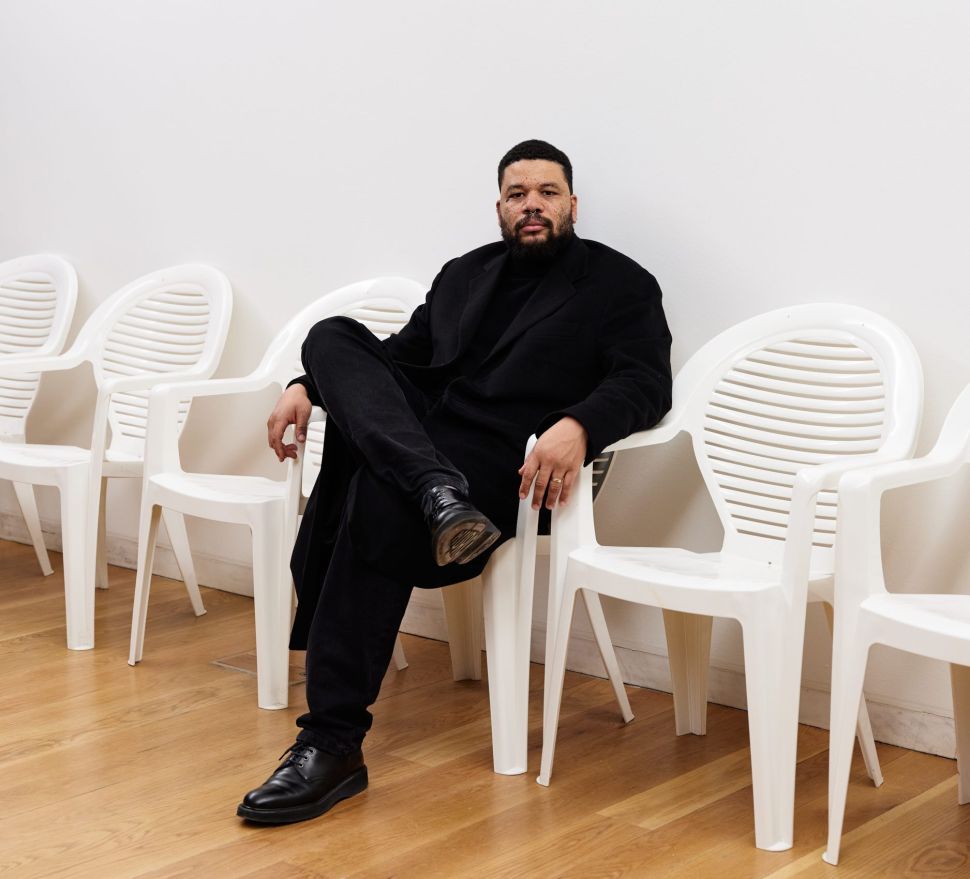
 Oscar Murillo seated on a white plastic chair in a gallery space, dressed in black, with a row of empty white chairs against a white wall behind him.” width=”970″ height=”879″ data-caption=’Oscar Murillo. <span class=”lazyload media-credit”>Photo by Tim Bowditch, courtesy the artist. Copyright © Oscar Murillo</span>’>
Those art aficionados who aren’t in Doha this week are likely in Mexico City for ZONAMACO. Every year during Mexico City Art Week, kurimanzutto, the city’s most prestigious gallery, stages an ambitious exhibition at its sprawling space in San Miguel Chapultepec, and this year’s, “oscar murillo: el pozo de agua,” brings together 15 years of work by the superstar painter. We caught up with the artist to hear more about the show, which is a can’t-miss if you’re in CDMX this week.
The press release for this show opens with a poem that makes reference to the “sedimentation of time.” What does that line mean for you, and how does it tie into the rest of the show?
Sedimentation of time references Frequencies as an index, an encyclopedic library, a universe in how I view the world—perhaps a gesture toward how different historical temporalities, experiences and layers of meaning settle and accumulate over time. It suggests history is not linear, but rather a coexistence of multiple, overlapping layers (structures, behaviors, events) that operate at different speeds, like a Flight drawing, the act of drawing at the speed of flight—say, at 600 mph or, differently, let’s say a 14-year-old child in a school in Singapore taking six months to contribute to the Frequencies database in 2014.
This show collects work from the last decade and a half of your practice. What’s it been like to see all of it together at the same time? Did you learn anything about yourself?
Time exists differently; it is not linear. So it is not a survey of time as your question suggests. Like the work, Telegram, it comes together through the sedimentation of time. Or like The water well, which is a moment of pause before you enter the exhibition. I think of it as a container of thought or a library of material and experience; it is not chronological.
How would you describe your relationship to the surfaces of your work? How has that evolved over the years?
These surfaces register marks and energy. I don’t have an obsessive relationship to the surface in the plastic sense of painting, but I do think about intensity both in the physical and psychological sense.
I liked your work at this fall’s São Paulo Biennial, wherein you placed surfaces around the building for others to mark. How did you come to this idea and how does it relate to the rest of your practice?
In many ways, Social mapping is an evolution of Frequencies with a very short performative tempo, as well as a different performative structure for the general public. In the context of a cultural institution and the streets themselves, it is also a device to record the passing of the masses, through the simple act of making a mark. On the other hand, Frequencies is a global network, it attaches itself to the framework and infrastructure of the school, and it collaborates with children as vessels. Social mapping coincides with this moment of censorship and turbulence we are living through, wherein layers upon layers of marks reveal the thoughts that people are freely recording and sharing, however trivial or profound.

When you were first starting out, you fast became a market darling. How does that experience inform the art you’re making today?
Your question is somewhat sensationalist. I am not a star of anything, I don’t recall such a time. I do remember continuous focus and experimentation in the studio.
What are the differences between how your work is received in Latin and South America versus elsewhere in the world?
Ideas in the work are borne out of a shifting global order that is currently under threat. Social mapping is perhaps a response to this. It is my way of being in the street as a witness.
Do you have a favorite work in the show? One that resonates with you for personal reasons?
The installation of The water well in the patio of the gallery space. It acts as a kind of encyclopedia. It contains fragments of material that have occupied space in my studio over the years. They are witnesses to my process. A fragment of material from my show “Espíritus en el pantano” at Museo Tamayo filled with marks from the public occupies one of the walls of the structure, for example. There are also large black canvas flags that I presented more than 10 years ago at the 56th Venice Biennale titled “All the world’s futures,” curated by Okwui Enwezor. There is a sound piece that is an account of my father’s migration from Colombia to London that is recorded in 18 different languages.
In this sense, The water well is a resource from which memories and material are extracted. Like a library, the visitor can come and consult it before viewing the paintings on show.
More in Artists
-
Adrian Parr’s Intimate Response to an Unthinkable World
-
Gulnur Mukazhanova’s Felt-Making as Philosophy
-
Hans van Manen Remembers Photographer Erwin Olaf
-
Artist Kathleen Ryan’s Beautiful Blight
-
An Interview with Anselm Kiefer, Iconoclastic Alchemist
Observer



Leave a Reply