
Something remarkable happened last week.
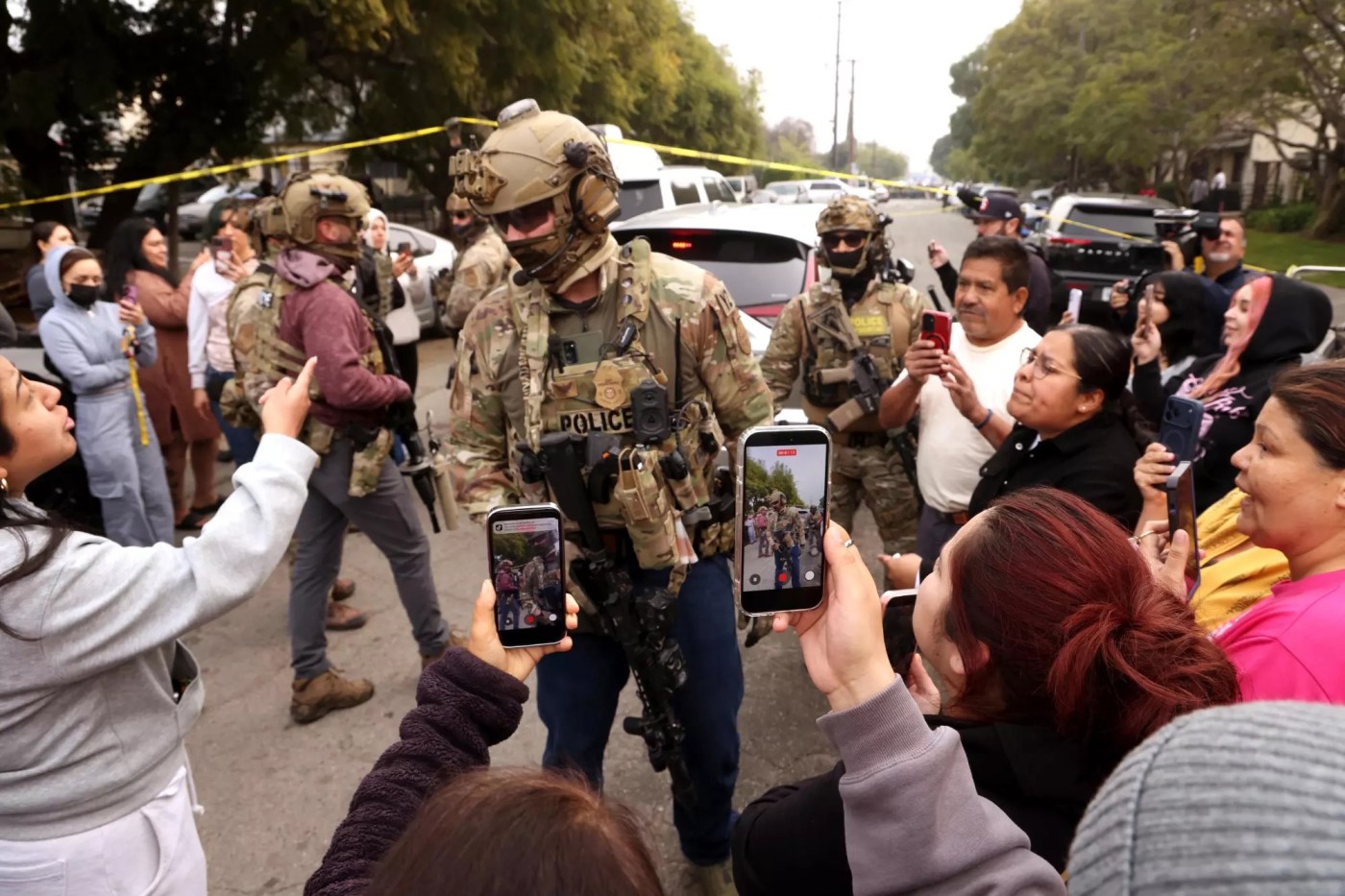
Gov. Gavin Newsom and Attorney General Rob Bonta warned California’s law enforcement officers that the Trump administration will try to obstruct local and state police investigations into killings by federal agents in California.
Let that sink in.
Invoking the recent fatal shootings of Renee Good and Alex Pretti at the hands of Homeland Security agents in Minnesota, Newsom and Bonta wrote that the federal government’s conduct in those and other recent cases “make clear that this administration not only will not investigate such incidents but will attempt to thwart other agencies from doing so.” California’s law enforcement, wrote Newsom and Bonta, have a legal and moral duty to hold federal agents accountable for state crimes they commit here.
But days away from hosting Super Bowl LX — an event many fear will bring a surge of President Trump’s federal agents to Santa Clara County — the district attorney here, Jeff Rosen, is losing sleep.
For he knows that carrying out Newsom and Bonta’s mandate will not be easy.
After a lifetime of working together with federal law enforcement officials, the veteran prosecutor admits he could no longer trust them to fairly investigate their own agents who kill someone in his county. And he has doubts about whether local police and prosecutors will be allowed to fill the void.
Rosen, like the rest of the nation, has seen the Trump administration deny Minneapolis police and Minnesota state investigators access to crime scenes, critical evidence and basic facts surrounding the deaths of Good and Pretti.
“The situation we’re all concerned about is if local police aren’t allowed to collect evidence or see evidence or are moved from a crime scene before they’re finished collecting evidence,” says Rosen, who has overseen the largest prosecutor’s office in Northern California since 2011. “We’re not looking to start a shooting match … between local police and federal agents. We don’t want there to be, literally, a physical fight. … We don’t want a civil war here.”
But it’s a scenario that Rosen has thought a lot about.
“That keeps me up at night.”
Right to worry
Erwin Chemerinsky, dean of Berkeley Law, is sympathetic to Rosen, and for more than one reason.
“We’ve never seen federal law enforcement acting this way,” says Chemerinsky, a Constitutional law expert. “We’re watching the militarization of federal law enforcement and (unprecedented) tensions between local police and federal (agents).”
UC Davis Law’s Gabriel Chin, who teaches criminal law and procedure, doesn’t mince words either.
Federal law enforcement officers “seem to be doing what they can to conceal or prevent the disclosure of bad policing by their agencies. … It’s bad, very bad — Jim Crow legal lynching stuff.”
However, while collecting evidence in the face of administration stonewalling is a new problem for Rosen and other local and state prosecutors in Trump’s America, it’s not their only obstacle to holding federal agents accountable. They face, arguably, an even bigger one from the U.S. Constitution.
Article VI’s Supremacy Clause makes the laws of the United States “the supreme law of the land,” and that has paved the way for other binding legal precedents giving federal officers substantial immunity from state crimes.
Their pathway to avoid prison is a two-step process.
First, if state charges against federal officers involve actions committed “under the color of office,” then the officers can move their cases from state to federal courts. What qualifies is highly subjective, but that ambiguity has overwhelmingly benefited federal officers, according to the two legal scholars.
Second, once federal officers succeed in removing their cases from state to federal courts, there is the question of immunity.
Under an 1890 legal precedent, federal officers are granted immunity from state crimes if the underlying actions were “authorized by federal law” and “necessary and proper,” among other subjective conditions.
Sobering reality
So then, how often have federal officers been found guilty of homicide after they removed their cases from state to federal courts?
Never.
UC Davis Law’s Chin says he can’t identify any time a federal officer has been convicted of state homicide charges in federal court.
In other words, federal officers have evaded exposure to state criminal law since long before Trump became president. But now with an administration that is actively trying to thwart state investigations that might rebut immunity defenses, like the officer’s actions were “necessary and proper,” holding ICE, Border Patrol or FBI agents accountable is even more remote.
Put bluntly, says Chin, the Trump administration is making it easier for federal agents to get away with murder.
Not losing sleep
Nevertheless, Attorney General Bonta says he’s not worried.
“I have no doubt that we can prosecute for murder,” Bonta says. “There is no world where federal law says their agents have a license to kill.”
Bonta points to a 2001 Ninth Circuit Court of Appeals decision that immunity is not a blanket shield for federal officers. That 6-5 ruling gave states an opening to charge federal officers with state crimes if they could prove the officers’ actions were not “objectively reasonable” to carry out their duties.
Legal scholars Chemerinsky and Chin agree with Bonta on the letter of the law: States can indeed charge federal agents with homicide in federal courts.
But it’s going to be up to prosecutors, like Santa Clara County DA Rosen, to turn legal theory into reality.
And he’s not assuming it’ll be easy, given the obstacles posed by the Supremacy Clause and Trump administration’s deliberate obstruction.
Since early in the Trump’s second term, Rosen says, he has expected that Homeland Security agents would end up shooting someone dead. His office has been gaming out scenarios like Minneapolis’ for several months with Santa Clara County-based law enforcement agencies – including those in charge of safety at Levi’s Stadium in Santa Clara on Super Bowl Sunday.
Local police departments and prosecutors are prepared to defend their investigations in the face of federal hostility, he says.
“If someone is shot in Santa Clara County, I will investigate,” says Rosen. “I took an oath to defend the Constitution of the United States — and the Constitution of California.”
Reach Deputy Opinion Editor Max Taves at mtaves@bayareanewsgroup.com.
The Mercury News



Leave a Reply