
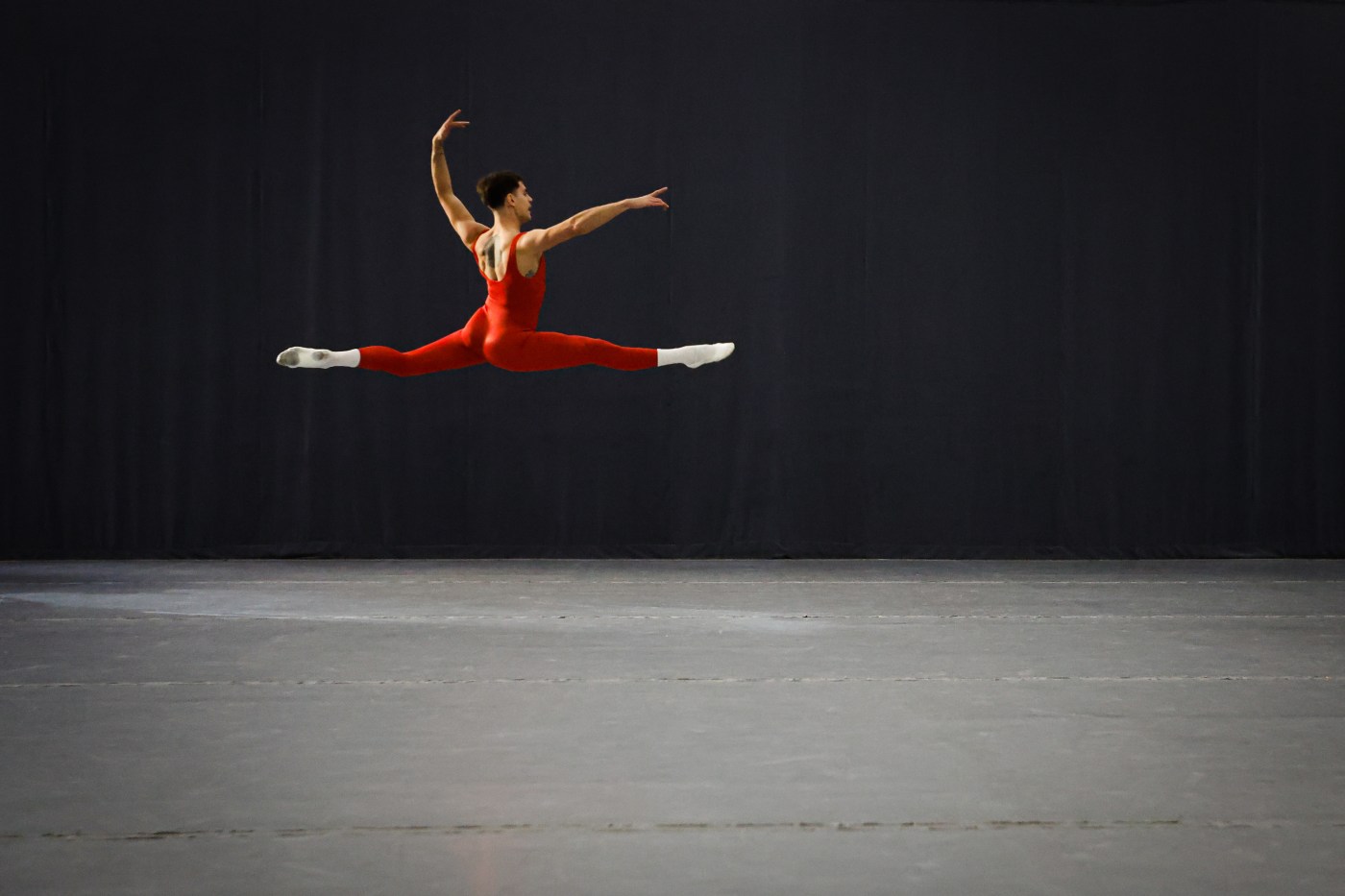
In the basement studio of the New Ballet in San Jose, a single figure crouched in a low lunge lifts his head, unfolding upwards like a flower turning toward a rising sun. He traverses the space in a series of gentle, sweeping steps as others come to meet him on the dance floor. With a sequence of delicate spins and gravity-defying lifts, he and the growing company of dancers seem to float across the room to the triumphant brass of Tchaikovsky’s “Nutcracker” music.
Breathtaking as the movement is, another, perhaps more wondrous ballet is taking place, largely invisible to the eye. Every time we dance – whether we are rehearsing for a classic holiday dance show or cutting a rug in our kitchens, a silent symphony of systems are firing up throughout our bodies to allow us to move it to music.
Decades of science reveal just how complex it is to move to the beat, show the incredible effects of dancing on our bodies and minds and even offer hints as to why – all across the world – we choose to dance in the first place.
How a body moves
Standing at his desk in his East Bay office, Michael Rowley begins a simple dance. He lifts his left foot slightly, bringing it through the air to gently touch the ground by his right foot before quickly sending the foot back to its original home, then his right foot mirrors the movement.
To the beat of a silent, internal metronome, he repeats the motion – step … touch … step … touch. The movement is simple – especially for a trained dancer like Rowley, who studies the biomechanics of dance at CSU, East Bay. But just that movement requires a mind-boggling coordination of muscles, joints and senses – Rowley estimates that a simple step-touch involves 40 muscles.
While we often think of five senses – a view that can be traced at least as far back as Aristotle – the last two millennia have offered us a far deeper understanding of how we experience the world around us, and in particular, how we sense our bodies in space.
“We can’t move without sensory input … then there is the complex coordination of multiple muscles at multiple joints – I mean, there’s so many levels to how the body controls that,” says Rowley.
Say you’re doing the Cupid Shuffle at a wedding, and have forgotten the steps since the last time you were at a reception. So you’re staring at the person in front of you hoping you don’t get lost. Even without looking at your body, you are recruiting a host of senses that we often don’t consider. With every step you take “to the right,” nerves that sense pressure and stretch tell you when the floor is beneath your feet and measure the shape of your body. Each time you lift your foot to go “to the left,” muscles all through your legs and core allow you to briefly balance, informed by tiny sensory organs tucked in your inner ears that let you know where you are in relation to gravity. As you “now kick” out your leg, nerves in your joints fire when they reach the extremes in their range, letting you know just how far you should extend your knee. And all throughout the dance, nerves attached to your muscles tell your brain the length of your muscles and how that length changes.
Feeling the beat
But before we even move a muscle, we need to feel the rhythm, which takes its own set of processes – and draws on our most basic functions.
For a while, most scientists thought that human beings were the only species that could match our bodies to rhythm, but recent research has shown that other animals can get down. Perhaps the most famous is Snowball the cockatoo, who went viral in 2007 after a video of him moving to the rhythm of “Everybody (Backstreet’s Back)” by the Backstreet Boys was uploaded to YouTube, but a growing menagerie of animals across species have been shown to move on beat.
Peter Cook is responsible for introducing the world to one more species of music-movers: the sea lion. Cook studies animal cognition at UC Santa Cruz and New College of Florida and over a decade ago, helped train Ronan the sea lion to bob to the rhythm of a metronome. Ronan then figured out how to bob to classics like “Boogie Wonderland” by Earth, Wind, and Fire and — again — to the Backstreet Boys. Cook’s research from earlier this year showed that Ronan could move to different tempos as well as or even better than some humans.
Cook notes that all kinds of animals need to move their bodies in reaction to sensory input to survive, whether it be a mouse escaping the swing of a cat’s paw or a sea lion chomping down on a fish after a silvery flash of scales. Moving to the rhythm takes advantage of those instincts, and adds on another layer – prediction. In order to stay on beat, we have to recognize the pattern and usually start moving before the beat even hits.
Humans are trained from a young age to react to and recognize rhythm: rocked as infants, introduced to children’s songs and nursery rhymes as babies and exposed to the music and dance of our cultures throughout our lives. As children get older, they get better at recognizing more complex rhythmic information, and both cultural exposure and musical training can help people get better at recognizing musical patterns.
So while Ronan the sea lion had to be trained to stay on beat, in many ways so do humans, argues Cook. We just happen to be exceptional at training each other.
Your brain on dance
In humans, that mix between sensory gathering, pattern recognition, prediction and motion involves regions all across the brain. Brain scans of dancers show that the parts of the brain that we use for movement, controlling our bodies in space and auditory processing light up as we dance – which we might expect. But dancing also activates regions associated with memory, planning, making strategic decisions and mood, as well as the brain’s reward center.
Because of this, several studies have suggested that dancing offers a host of benefits that stretch far beyond movement or fitness, including improvements to overall brain function, spatial recognition, mood, visual processing, communication and social interaction. Though many of these studies are small or observational (meaning they don’t involve a direct experiment), Nicole Corso, a Stanford neuroscientist and former competitive dancer, says that the evidence points to dance forging new connections throughout our brains in ways that improve our daily lives.
“(Dance) involves a lot more complexity, not only in terms of the movement but the way that you’re thinking about the movement, the emotion that’s coming through,” says Corso. “That could be what’s associated with those other improvements.”
That’s true even for those who have the most difficulty with movement – several studies have shown improvements in those with Parkinson’s who participate in dance classes. They have fewer falls, improved balance and even improved cognitive performance, says Corso. And in 2003, a study of active hobbies from golfing to tennis found that only dance lowered risk of dementia.
“(Dance) has some part that is deep-seated in the human condition, but also it does have this very neurological component that activates certain regions of the brain that are super useful for daily activities,” says Corso. “It really has great impacts on brain function and structure.”
Cheesecake and community
Even as research unravels the incredible processes that go on every time we dance and studies show how that benefits our bodies, we are still left with a more fundamental question: why do we dance?
For humans, dance is everywhere. Cave paintings showing what looks like group dance go back 10,000 years, and evidence of music goes back even further, with flutes made of animal bones dating up to 60,000 years old. Every human culture known to science has some form of dance – remarkable for something that, on face value, does not satisfy any basic need for sustenance or procreation.
“It’s such a weird thing. We have these bodies that we train to be functional, right? We teach it how to eat. We teach it how to walk. We teach it to be able to work in the world to be productive and efficient,” says Sima Belmar, who researches and teaches on dance and movement at UC Berkeley. “Dance is kind of a non-efficient mode of moving the body, like it’s actually asking the body to do things that are not necessary.”
While the biologist Cook notes that “human culture passes on all kinds of weird arbitrary things,” the universal nature of dance hints at something beyond that.
“There’s something different about dance,” he says. “There must be something fundamentally appealing about it, or it wouldn’t be the case that cultures everywhere were passing it along.”
As to what that is, Cook points to two hypotheses. The first is that our love of music, and dance along with it, is just a happy accident of natural selection – tapping into our evolution to evoke delight. To explain this, Canadian psycholinguist Steven Pinker compares music to “auditory cheesecake.” While we didn’t evolve to like cheesecake, we evolved to like energy-rich fats and carbs. Cheesecake and other sweets take all the fats and carbs that used to require hunting and gathering on the savannah and pack them into a hard-to-resist treat.
So too, with music.
We are primates who evolved to use language and recognize patterns, which means we are very good at honing in to changes in pitch, intonation, timing and rhythm. Music tickles all of those evolutionary traits that allow us to create and understand language and squeezes all the patterns and variations into a concentrated form. Dance takes it one step further – embodying those patterns and putting all of our ability to move and balance into play.
Without meaning to, some dancers may reflect this theory of delight in how they discuss their art form. “As a dancer, I’ve never been interested in the neuroscience, the psychological science around dance,” says Belmar. “Human beings dance, we’ve always danced … because it’s awesome, it’s good for you and it feels good.”
The second hypothesis sees dance as a deeply social creation. Here, Cook points to a body of research that shows how moving in time helps us empathize with those around us and build social bonds. Different studies suggest that walking at the same pace might make people more likely to cooperate, tapping fingers at the same tempo could improve feelings of affiliation and drumming the same beat or mirroring each other’s movements might make us more likely to help each other out.
For a species that relies on group coordination for virtually every aspect of survival, dancing could be part of the social glue that helped us and our cultures survive the ravages of time.
Dancers themselves hint at the connective power of shared movement. Dalia Rawson, now the executive director of New Ballet in San Jose, spent decades training and refining her craft as a ballet dancer, and says that after rehearsing for weeks on end with the other members of her company, something special happened. “There’s a ritualistic factor to it … It’s like a flow state, you have to let go of some control,” recalls Rawson. “It’s one of the most satisfying things when you move together. It’s beautiful.”
Back in the studio that she runs, three dancers put that synchronicity into practice. The triad moves across the grey room in a dizzying chain of matching pirouettes, drawing a slow circle one after another as arpeggiating harp fills the bare space with sound. Their every motion relies on a vast network of senses and systems, perhaps tapping into ancient evolutionary hardwiring to synchronize into crisp choreography.
“There’s a meditative and almost prayerlike state,” says Rawson. “There’s a real magic to it.”
Watching the dancers draw their hypnotic pattern across the room, it’s easy to see that – magic, carved into place by the mysteries of what bodies and minds can do.
The Mercury News



Leave a Reply