
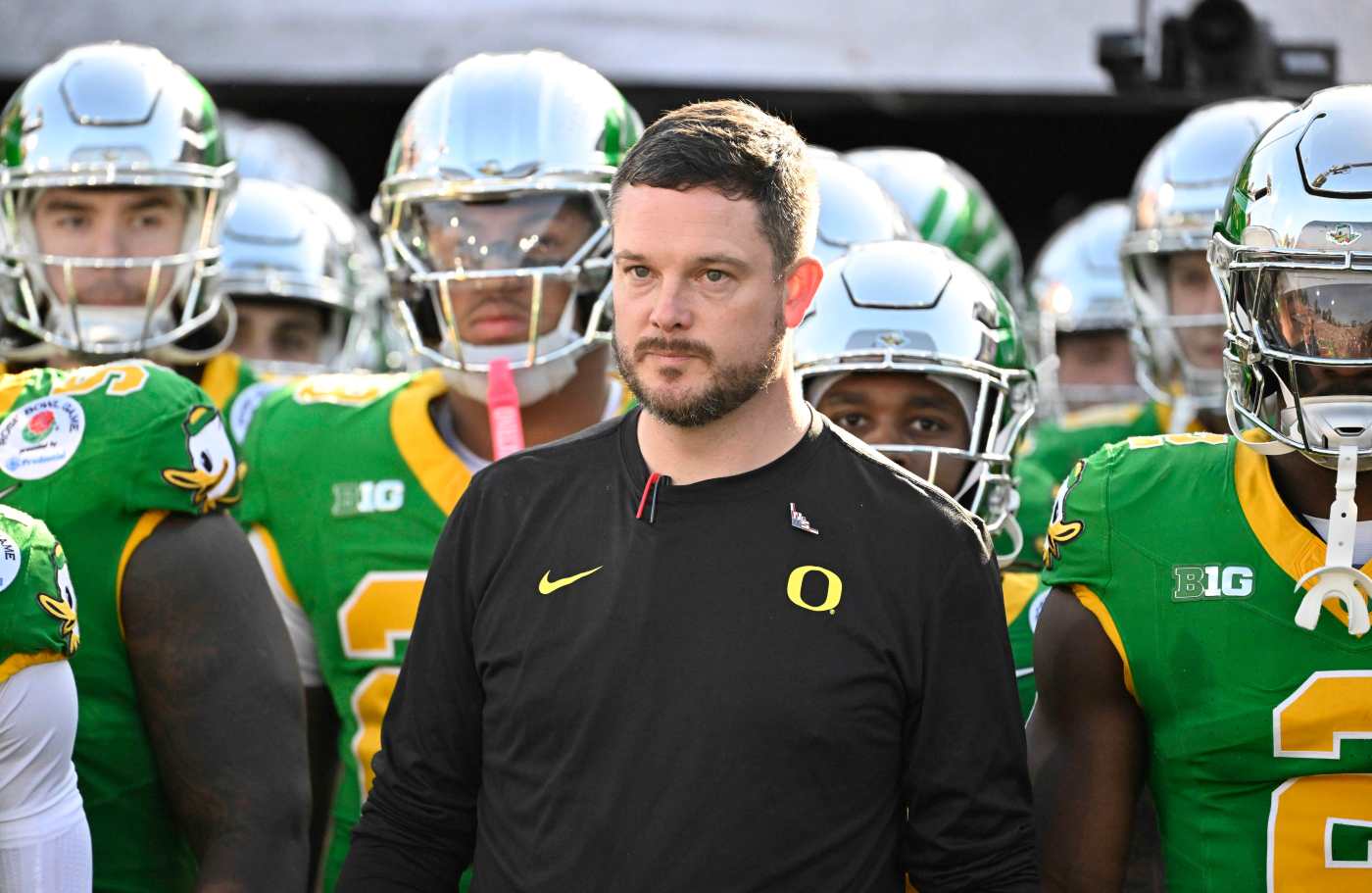
Time to whack the button in Eugene. But which one?
Certainly not the eject button. Dan Lanning is the ideal coach for Oregon. He relates well to players, represents the university in first-class fashion, never loses to lesser teams and wins at a rate few peers can match.
Or the panic button. With their infrastructure and resources, the Ducks are built to win at least 10 games per season in the era of revenue sharing, third-party NIL and the transfer portal.
Or the snooze button. On-field success is more important than ever as a marketing vehicle for the university during the expected enrollment decline and with the threat of a super league looming over the sport.
The reset button? That’s the one. Because clearly, the Ducks have plateaued. They are a College Football Playoff regular that’s far from championship caliber.
How far? That’s easy: 54 points.
In their most important games of the past two seasons, the Ducks lost by 54 points.
They were blasted 41-21 by Ohio State in the quarterfinals last year and humiliated 56-22 by Indiana in the semifinals on Friday night.
They could not topple the sport’s old guard in Pasadena and, in a humbling development, had zero answers for the new kid in town in Atlanta.
Even worse: Mario Cristobal, who preceded Lanning and was subsequently deemed the lesser of the two by legions of Oregon fans, has advanced deeper in the CFP than Lanning and stands one victory away from the championship.
The January vibes are, once again, suboptimal.
Of course, it could be worse. Oregon could be any of the roughly 125 FBS teams, including USC and Washington, that would trade places instantly. They would trade their support for Oregon’s support, their record for Oregon’s record and their coach for Oregon’s coach.
And yet, something doesn’t add up.
Losing to Ohio State and Indiana in the CFP isn’t the issue. The issue is the fashion in which the Ducks lost the Rose and Peach Bowls.
Both showdowns were rematches of competitive games, but the Ducks were not competitive when the lights were brightest. They beat Ohio State by one point in October 2024, then trailed 34-8 at halftime of the quarterfinals. They lost to Indiana by 10 points in October 2025, then trailed 35-7 at halftime of the semifinals.
Yes, they were rusty from the three-and-a-half-week layoff prior to the Rose Bowl.
Yes, their running back unit was depleted for the Peach Bowl.
But those issues don’t fully account for Oregon’s performances, which tells us a reset is required — that something is wrong with the schemes or the teaching or the preparation.
Only Lanning can uncover the glitch in his system that left the Ducks embarrassed in the biggest games of the past two years against opponents they previously proved they could play with.
Close games in October.
Blowouts in January.
That doesn’t add up.
Fortunately for the Ducks, a natural reset has materialized. Both coordinators, Will Stein (offense) and Tosh Lupoi (defense), have departed for head coaching positions at Kentucky and Cal, respectively.
Were they the cause of Oregon’s awful showings in the Rose and Peach Bowls? Not in our view. Did they contribute, in some fashion, to the face plants? Of course they did. Coordinators are charged with designing and implementing the game plans. And in both matchups, the Ducks were out-coached. In both games, the Ducks were not ready to compete for 30 minutes, much less 60.
Two things, equally true: Stein and Lupoi earned their opportunities in Lexington and Berkeley; and this is a good time for them to move on.
Are their replacements up to the task?
The Hotline has long believed Lanning, for all his appeal and success, needed an older, wiser coaching staff, especially at the coordinator level.
To win games deep in the CFP, to beat opponents with comparable talent, you need equivalent expertise.
The Ohio State and Indiana coaching staffs that sliced and diced the Ducks had decades more experience at the head coach and coordinator levels.
And yet, Lanning promoted from within to fill the coordinator vacancies.
Lupoi’s replacement, Chris Hampton, has never called plays at the Power Four level, while Stein’s replacement, Drew Mehringer, has one year of coordinator experience at the Power Four level: For a Rutgers offense, in 2016, that finished No. 127 in the country in scoring.
Granted, Mehringer was in his late 20s at the time and is undoubtedly more knowledgeable and qualified a decade later. Same with Hampton. Both coordinators know Oregon’s personnel and the schemes and are aligned with Lanning.
But is more of the same the solution?
To be clear: There’s zero reason to expect the Ducks to regress with Hampton and Mehringer calling plays across 12 Saturdays next fall.
Combine the talent with the culture and Oregon should once again contender in the Big Ten and for the CFP.
But contending isn’t the aim; reaching the playoff isn’t the goal.
The goal is the next step … the final step.
The Ducks appear so close and, at the same time, so far.
*** Send suggestions, comments and tips (confidentiality guaranteed) to wilnerhotline@bayareanewsgroup.com or call 408-920-5716
*** Follow me on the social media platform X: @WilnerHotline
The Mercury News










Leave a Reply