

Brooklyn-based Zoë Buckman has made her name through a bold approach to textile and embroidery—a medium long associated with subordinate female labor—transforming it from a vessel of generational memory into a stage for broader sociopolitical commentary and denunciations. In her work, embroidery moves from the domestic sphere into the political, turning traditionally feminized labor into a mode of testimony while also celebrating and crystallizing intimate moments as representations of broader, universal human states.
Buckman’s practice has long centered on gender disparities, challenging representations of women by asserting—through her authorship—not only control over the historically masculine gaze but also the autonomy of expression and self-definition that emerges through an inverted dynamic empowering her subjects in both their physical and emotional realities. With her latest show, which opened during Art Basel Miami Beach at Mindy Solomon Gallery, the artist shifts toward a wider lens, seeking to claim the dignity of—and elevate—the Jewish community she belongs to, moving beyond stereotyped portrayals and addressing the discrimination and isolation it has faced amid the ongoing backlash to the war in Gaza.
Buckman’s background was initially in photography, she explains to Observer as we walk through the show. Photography remains the starting point for these embroideries, allowing her to capture the humanity of her subjects as it manifests in the moment.

“I started in photography. That was where I got my art education,” she explains, noting how she still goes everywhere with her little film point-and-shoot camera. “I’m always looking for that genuine, authentic expression beyond any kind of structure—the moment: these authentic moments between people in my life,” Buckman adds. “Sometimes it’s between me and someone close to me, or sometimes it’s just a moment when humanity happens to manifest.”
Drawing its title from Leonard Cohen’s haunting reinterpretation of the Jewish prayer Unetaneh Tokef, the exhibition’s themes of mortality, judgment and spiritual reckoning and reawakening echo through Jewish ritual and lived experience. Each subject is depicted in a moment of inner reawakening—confronting emotional fragility and vulnerability while also embracing the expansive potential of their inner life. They share this richness deliberately, even when such imaginative and psychological responses run counter to the rational systems of productivity and functionality that dominate contemporary life—a society that, in doing so, appears to have lost one of its most profound values: empathy and the awareness that we are all interconnected in a network of vital interdependencies beyond racial, religious or social categories shaping today’s divisions and deepening polarization.
Based on photographs of family and community members in intimate, domestic settings, these works invite us to recognize shared humanity beyond classification. In the process, the artist undertakes a deeply personal exploration of Jewish identity through cultural and material rituals that preserve intergenerational memory and embody collective resilience—while also probing the universality of these private moments and emotional states.

Throughout her practice, Buckman employs an original visual lexicon that combines ink and acrylic painting on vintage domestic textiles, which she then hand-embroiders. Sewing and stitching these threads around the images to help those moments materialize with emotional warmth is a time-intensive process—one that inherently reflects the dedication and care required by all genuine and meaningful human encounters.
Combining introspection, tenderness and radical presence, the raw sensual symbolism and materiality of these works operate as both mirror and balm. “When I first started, I was celebrating the tradition itself—the craftsmanship, the legacy of women, the history behind embroidery and appliqué,” Buckman explains. Sewing becomes a way to retrace that thread, reconnect with that legacy and keep it alive, as the textile work regains its ancestral function as an archive—a repository of personal and collective memory and storytelling. The textile and embroidery medium absorbs experience like skin: soft enough to bear wounds, yet strong enough to endure handling, mending and reconfiguration. Still, the way threads come loose or begin to fall away gestures toward a different reading, as Buckman notes. “It’s a question of what exists beyond the tradition. Are these figures emerging, or are they disappearing?”
Thread holds time; becoming presence and figure, each stitch marks a moment, a choice, a return—an accumulative record of presence that resists erasure. Yet Buckman also makes room for disintegration. The undone quality that defines her work allows for imperfection and visible labor, acknowledging and honoring the fragile humility of human history in all its ephemeral, transient nature.

“There’s this tension in the thread: it looks like it’s holding everything together, but it’s also coming apart,” Buckman observes. “I’m playing with that moment where the image feels like it’s either dissolving or coming together—precisely that space.”
Much of Buckman’s recent work, as she admits, has centered on grief, spirit, and connection, with her artistic practice becoming a means of maintaining bonds with those she has lost. She sews her trauma directly into fabric, as the slower tempo imposed by sewing, stitching, and embroidery allows her to pause and interrogate deeply personal experiences and transitions. Only by entering that space of introspection and meditation—stepping outside the relentless flow of modern life—can one begin to process emotional change and, ideally, find a space for healing. Here, memory becomes something physically and emotionally metabolized through the hands.
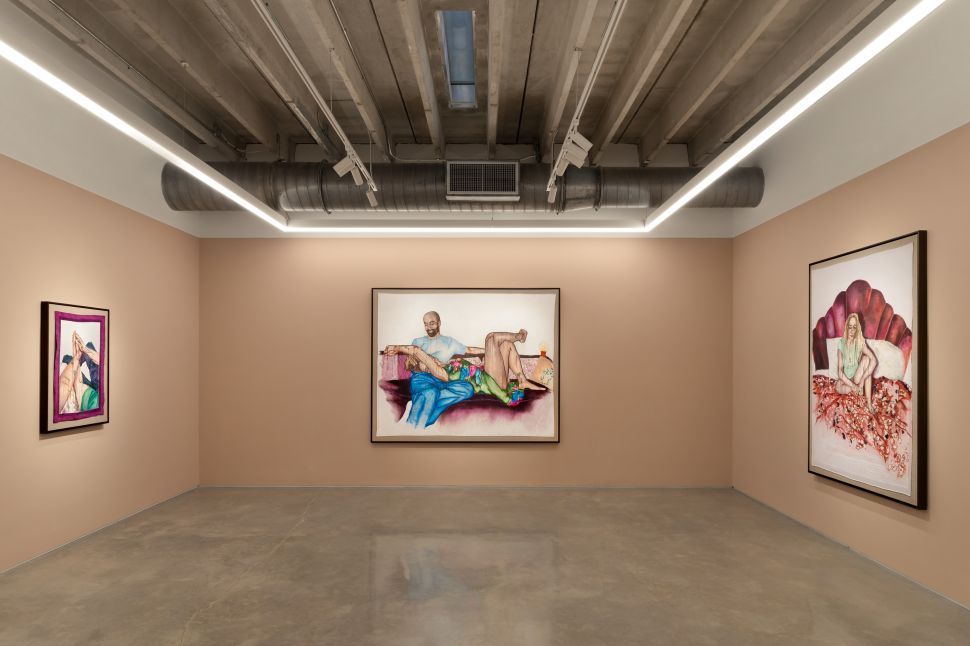
For the first time, Buckman includes a work in this show that also depicts a man. “My work about my relationships with men has usually focused on the difficult experiences I’ve had—things that were said or done to me,” she notes, acknowledging the piece as a possible step toward a more tender place of reconciliation, healing her conflict and painful resentment with the masculine. The man in before they became an outline (2025) is actually a gay friend, she explains. The image distills a moment of genuine admiration and affection between two friends, where the feminine side nonetheless remains the center of emotional and psychological attention and tension.

The male figure is looking down toward a blonde woman in his arms, the threads flowing around her body. “That’s Katie. She’s the woman who has appeared most often in my work,” Buckman explains, expressing deep admiration for someone who defies stereotypes: a nurse and two-time cancer survivor who has endured countless challenges yet still holds a powerfully seductive and magnetic presence. “She lost her mum when she was 18, so we share that grief of not having our mothers around. She’s been through similar experiences to mine when it comes to power, to assault,” Buckman explains. “She’s the most audacious, so sexy. When you meet her, when she walks into a room, she commands the space. She’s really a muse for me: she’s endured so much, and yet she’s radically attractive.”
The subject of a woman with red hair in trace your ridges (2025) similarly claims, fearlessly and unapologetically, all the attention her energy and beauty demand. One of the very few self-portraits Buckman has made, the piece is based on a photograph taken by her boyfriend, she explains. She had never previously allowed that kind of dynamic into her work. But by doing so now, she reclaims the image, folds her own perspective back into it and reconciles with the memories it carries. The female figure remains at the center, now asserting full ownership of the sensuality that once drew the potentially abusive masculine gaze. She is still the axis everything revolves around.
At the same time, with this show, Buckman appears to shift her focus more toward a broader, collective experience of intergenerational trauma—still unprocessed and once again denied the space for reflection and recognition that true healing requires.

“I think it’s also important to note that when I started this series, there were works that were taken off the wall or sent to an art fair and then not exhibited because of the apparently hostile climate in the art world, in the aftermath of the Gaza war,” she notes. “These are my Jewish family and I, and these works were somehow censored just as there was a piece with a little gold Star of David. This raises new questions about who is represented in art today and how entire communities are still erased.”
This question of representation is also what brought Buckman to engage directly with art history in some of her subjects. smells like light (2025), for instance, was inspired by a painting she saw at the Henry Taylor retrospective at the Whitney, which had itself been inspired by a work by Richter and could be linked further back to Vermeer. “That was his interpretation—his version—of a Richter painting and I loved how Henry Taylor was appropriating it to speak about his own community, about who gets left out of the canon of art history,” Buckman notes. Her version shows a woman in profile, her body turned away from the viewer, her head wrapped in a striking golden-yellow headscarf rendered with soft folds and highlights that echo the sinuous movement of her robe, covered in dense, vivid red floral embroidery that creates tactile depth and vital motion. “I wanted to create something that looks at a Mizrahi, modern Orthodox Jewish woman, because I also feel that these are also people and identities that are left out of the canon of art history.”
This is also why all the works are made on repurposed textiles using traditional techniques; her canvases are bed sheets and tablecloths that have often been passed down through generations. “They all already hold stories, carry memories; they revive the legacy of other women for me,” she reflects.

Already embedded in these materials are stories of intergenerational trauma, resilience and resistance. These textiles function as a site of repair, where Buckman tries to pull the threads together again—mending memory without concealing what is broken, allowing the chaos and hardship revealed by the falling strands to remain visible. “I get to build upon the stories that were already there, the ones we don’t know about. Were these textiles treasured? Were they discarded? We don’t know,” she says. “We don’t know who the women were who handled them. Discarded or cherished, they still carry something forward.”
The only text-only work in the show underscores the connection between thread and text, as these textile pieces become vessels for preserving both individual and collective memory. “& still women will tell a woman or what remains of her bones that they are lying,” reads the blue embroidery in crows on the tracks (2025)—a cryptic, poetic allusion not only to the historical tragedy of the Holocaust but also to the ongoing erasure of domestic violence, both past and present. While Buckman has long addressed this denial in her work and public presence, she created this piece during a period of reckoning with how deeply Holocaust denial and the gaslighting of antisemitic experience continue. “One of the most heartbreaking and disappointing things I’ve witnessed in the last two years has been seeing women—feminist women, highly educated women, activist women—denying the rape and sexual assault that happened to people in my community. Immediately, even now, it gets rejected. Jewish women are told they’re making it up.”
In the threads of Zoë Buckman’s dense emotional storytelling, trauma—both individual and intergenerational—is not erased but held. It is rematerialized as witnessed emotion and reconfigured into powerfully dramatic images that affirm the profound humanity within each scene. Through the visible labor of sewing itself, the gesture of repair becomes more than a metaphor—it becomes a vital part of the story.

More in Artists
-
How Jorge Pardo Turns Light, Color and Form into a Phenomenology of Seeing
-
The Early Experiments of Manoucher Yektai
-
Hans van Manen Remembers Photographer Erwin Olaf
-
Marina Abramovic’s Erotic Epic Spreads Wide (and Displays the Limits of) the Artist’s Psyche
-
An Interview with Anselm Kiefer, Iconoclastic Alchemist
Observer








Leave a Reply